AI-controlled bioreactors open doors to faster, more precise enzyme production
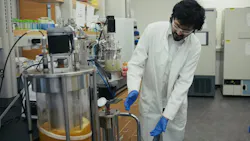
Researchers have developed bioreactors controlled by a machine learning (ML) framework that continuously monitor critical bioprocessing parameters in real time to boost enzyme production, improving batch consistency and ultimately accelerating the path to market.
The artificial intelligence (AI)-powered bioreactor was developed through a collaboration between Iowa State University (ISU) and biosolutions company Novonesis — with project funding backed by BioMADE — to improve final product quality and hasten market entry.
The goals behind the project were straightforward: to improve enzyme production by creating reactor sensors that continuously monitor processes that previously had to be measured manually, and to develop sharable open-source software for improved bioreactor monitoring.
“This was a fabulous opportunity to bring together new measurement and analytical techniques that truly measure what you’re trying to get out of the bioreactor,” said David Nathan, program director at BioMADE. “Oftentimes we measure temperature, optical density, how many cells have grown in the bioreactor, how much oxygen has been used up by the microbes — but this doesn’t really get to a measurement of the desired output; the thing we’re trying to get the microbes to make.”
An additional benefit of the project was the relatively low cost of developing the bioreactors, which the researchers contend make the technology useful for biomanufacturing education.
Building the AI model
BioMADE, a nonprofit collaborating with public and private entities to advance sustainable and reliable bio-industrial manufacturing technologies, is funding a series of projects aimed at advancing bioprocessing.
This project was designed to create a bioreactor that could be controlled and optimized through a reinforcement learning (RL) agent. ISU collaborated with experts at BioMADE and Novonesis to design a digital twin to “demonstrate R-based control and a bioreactor array system to obtain the real-time variables — like enzyme activity level and cell concentration — necessary to train the RL agent.”
The initial AI and machine learning build was done in silico on the computer “working on things we knew about bioreactors — with data provided from Novonesis of how typical reactors are run at Novonesis — in an attempt to start a preliminary training so that the AI model was giving us answers that made sense from what we knew of the real world,” Nathan said.
Data from the digital twin was compared with findings from actual reactors to validate that the machine learning tool could accurately replicate what was tracked in the real-world environment. Subsequent findings were then used to further improve on the build of the machine learning agent.
“Once we were able to build that digital twin, the next step was to move on and start doing training in real-life reactors at a small scale to validate that the machine learning tool could replicate the data and the performance it was giving in the computer model in the real world,” Nathan added. “Having both side by side as they build off each other, you get data in the real world helping you put better rules into the AI model and can continue to refine that rule set.”
Improved variability management
A significant takeaway from the development and practice of this AI model was its ability to respond to bioreactor variability and recover from operational upsets.
Nathan compared the ML-based tool’s ability to deal with production variability — such as changes to temperature, pH value, and oxygen levels — against traditional distributed control systems (DCS) that are used in industrial processes to manage and automate complex operations.
“This particular system really can start to outperform traditional proportional-integral-derivative (PID) controllers (part of a DCS) and is able to deal with more random variables that can happen and bring the entire system back online or back to an optimized performance, even with relatively unexpected situations,” according to Nathan.
The team observed how real-world data collected to inform the ML-framework significantly helped in its ability to respond to process upsets.
“In a way, it's like taking the tribal knowledge from somebody who’s monitored cultures for 20 years — if an upset happens, they know based on historical information how to respond,” said Mike Hess, senior regional technology manager at Novonesis. “It’s getting that actually into something that then could be codified and then used 100% of the time, not just when your most experienced and best operator is the one that’s monitoring the culture.”
Following findings from the project, the researchers said they are currently partnering with a private sector company to develop a highly autonomous bioreactor with the goal of better enabling the scale up and production of more products.
From research to education
While the project’s primary targets were to develop a solution that could monitor enzyme activity and gather data to reinforce the learning AI model, it also helped cultivate an educational initiative at ISU.
Because the researchers needed a “small array of reactors” for the project, they used common parts to build their own small bioreactors for around $300 apiece, ultimately creating a cost-effective bioreactor design, according to Hess.
“It was an unintended benefit of this project, but as the need arose to run lots of multiple reactions to train the machine learning tool, ISU was able to develop this really low-cost reactor kit using off-the-shelf available parts — it was bare bones, but effective,” said Nathan.
The collaborators on the project realized that these low-cost reactors could be used to train students in bioprocessing. The systems are now being developed as educational kits that ISU calls Bioreactor Educational Activity Kits, or BREAKs.
“You don’t really know how something works until you have something that you can take apart and break,” said Nigel Reuel, an associate professor and the Stanley Chair in interdisciplinary engineering at ISU. “The idea is that the bioreactor that comes in a box … students can play around with it, build it, grow their own bacteria … at a cost point where it’s not prohibitive.”
Related Listening
In the following episode of Off Script, we connected with Mike Hess, senior regional technology manager at Novonesis, and David Nathan, program director at BioMADE, to discuss the development of the new bioreactor and how real-time monitoring and AI-based control help manufacturers automate previously manual processes, improve batch consistency, and ultimately accelerate the path to market.
About the Author
Andy Lundin
Senior Editor
Andy Lundin has more than 10 years of experience in business-to-business publishing producing digital content for audiences in the medical and automotive industries, among others. He currently works as Senior Editor for Pharma Manufacturing and is responsible for feature writing and production of the podcast.
His prior publications include MEDQOR, a real-time healthcare business intelligence platform, and Bobit Business Media. Andy graduated from California State University-Fullerton in 2014 with a B.A. in journalism. He lives in Long Beach, California.