Continuous upstream bioprocessing makes headway in biomanufacturing
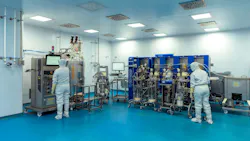
Automation technologies for bioprocessing are on the rise as automated batch control systems for bioreactors continue to make headway. That’s among the findings of BioPlan Associates’ 23rd Annual Report and Survey of Biopharmaceutical Manufacturing Capacity and Production.
Continuous upstream bioprocessing innovations remain a top interest as the industry grapples with operational issues in biomanufacturing and seeks improvements in their operations that lead to cost efficiency wherever possible. At the same time, operator errors are the most persistent cause of batch failures.
“This report clearly indicates that better automation and monitoring are in high demand from end-users. Part of this is due to the expectation that automation can remove human errors in bioprocessing,” states BioPlan. “The data show that equipment suppliers are increasingly focusing on automation and how it can be integrated into standardized design and processes.”
With continuous manufacturing, processes operate at a steady state rather than through discrete batches, requiring more sophisticated automation and process control. Automated batch control systems for bioreactors over the past decade and a half have evolved significantly. From a low of around 10% with the intention of planning to adopt these systems in 2011, bioreactor automation is being implemented by nearly 40% currently.
Although fewer facilities are experiencing capacity challenges today due to downstream processing equipment challenges, when it comes to continuous upstream, BioPlan’s study/survey of bioprocessing professionals found that bioreactor automation and control systems have “surged” to 38.6% adoption/planned implementation.
“Globally in 2026, biologics manufacturers are in the middle of a major bioprocessing capacity expansion, driven by surging demand for monoclonal antibodies, cell and gene therapies, and biosimilars,” according to BioPlan. “The expansion is characterized by heavy investment in single-use technologies, continuous manufacturing, and regional hubs in Asia, Europe, and North America.”
While fixed stainless steel equipment continues to dominate commercial-scale manufacturing, the report expects significant growth in single-use systems revenue as single-use equipment — particularly for upstream manufacturing (bioreactors) — are adopted for commercial manufacturing as new products advance through the pipeline.
Continuous processing, perfusion
In BioPlan’s global survey, 42.3% of respondents indicated that they will be evaluating upstream continuous processing/perfusion at their facilities this year, while the cost of perfusion and continuous bioprocessing appears at the bottom of the list of decision attributes.
BioPlan has previously noted that one of the broad areas of concern over perfusion processes has been cost. However, in its 2025 survey/report, just 19.4% of respondents considered cost a “much bigger” concern versus batch processing, while the percentage of industry not evaluating or considering continuous upstream bioprocessing is nearing single-digits — only 11.4% of respondents, down by more than three-fold (34%) from 2016.
Although batch and fed-batch processes dominate, demand is growing for perfusion-ready systems, high-cell-density processing, continuous manufacturing, and digitally connected operations. Unlike fed-batch processes, perfusion continuously supplies fresh media while removing spent media, allowing cell cultures to remain productive for longer periods. The approach is designed to improve productivity, maintain more consistent culture conditions, and reduce the buildup of metabolic byproducts that can impact product quality.
At the same time, while perfusion may increasingly be used at the lower end, for small quantities, its use is still rare for commercial monoclonal antibody (mAb) manufacturing, according to BioPlan.
“Relatively few mainstream commercial mAb products are manufactured using single use/disposable bioprocessing systems, and even fewer are using substantial continuous bioprocessing. However, this is changing and over the next few years as products that are currently in pipeline development using single-use systems and/or continuous bioprocessing advance in development enter the market,” BioPlan said.
Single-use systems and continuous bioprocessing, along with the concurrent automation required, are “some of the important technologies which will shape the future of bioprocessing industry,” the report concluded.
CDMO investment grows
Contract development and manufacturing organizations (CDMOs) are becoming more widely leveraged in biologics production by increasing their capacity, global reach, and use of technologies such as continuous bioprocessing and single-use systems.
Last month, U.S. CDMO Cytovance Biologics expanded its upstream process development services with the addition of perfusion capabilities. The company says the new service offering provides biopharma companies with an additional process development option alongside traditional fed-batch manufacturing for mAbs, recombinant proteins, and other biologics. The capability is intended to support programs that require higher productivity, longer cell culture durations, and greater manufacturing flexibility.
Last year, China-headquartered global contract research, development and manufacturing organization WuXi Biologics announced that its intensified perfusion culture process platform achieved end-to-end, fully automated continuous drug substance production at pilot scale. The company said the system is being deployed at its major Good Manufacturing Process (GMP) facilities to improve production efficiency and flexibility.
Single-use systems
According to BioPlan, the percentage of biopharmaceutical manufacturers leveraging single-use perfusion equipment at any stage has doubled from 33.1% to 65.8% over the past decade. While early efforts at continuous biologics manufacturing often fell short of fully integrated production, advances in single-use bioreactors, tubing assemblies, and continuous chromatography have made the approach more practical.
“This year we see that single-use bioreactors at 500L scale have seen a record high, at 25.4% compared to 18.6% in the previous years,” BioPlan said in its report. “Single-use bioreactors of 10L have seen a record low compared to all other years at 4.6% more than half of what has been reported in previous years.”
BioPlan also examined the average bioreactor capacity (in liters) across facilities. Their survey results showed a steady, long-term upward trend in the average volume of single-use bioreactors in active use. In 2026, the average single-use bioreactor capacity increased again to 880L compared to 832L in 2025. Over the past eight years, the data show an overall increase in average single-use system volume of 67%, compared to 527L in 2018.
While BioPlan makes the case that dedicated stainless steel facilities still can’t be beaten for lower cost commercial manufacturing of large-volume products, the firm notes that “newer platforms include continuous bioprocessing and other process intensification technologies that can support more single use at commercial manufacturing scales.”
Charlie Heise, associate director of bioprocess strategy and development at global CDMO Fujifilm Biotechnologies, told Pharma Manufacturing that one of the biggest opportunities for single-use technologies lies in process intensification, as manufacturers look to maximize the use of resources required to manufacture biologics.
“I think that’s probably the piece where we’re going to see the most exciting stuff in the single-use space,” Heise said. “Which is around how can we really drive intensification of the use of the raw materials that we’re putting into the processes and how we are driving intensification around the energy consumption as well to be able to make sure that we’re getting the best and the most out of all of the resources that go into manufacturing medicines.”
About the Author
Greg Slabodkin
Editor in Chief
As Editor in Chief, Greg oversees all aspects of planning, managing, and producing the content for Pharma Manufacturing’s website and digital products, as well as the daily operations of its editorial team.
For more than 20 years, Greg has covered the healthcare, life sciences, and medical device industries for several trade publications. He is the recipient of a Post-Newsweek Business Information Editorial Excellence Award for his news reporting and a Gold Award for Best Case Study from the American Society of Healthcare Publication Editors. In addition, Greg is a Healthcare Fellow from the Society for Advancing Business Editing and Writing.
When not covering the pharma manufacturing industry, he is an avid Buffalo Bills football and Buffalo Sabres hockey fan, likes to kayak, and plays guitar.