3 ways Thermo Fisher will benefit from US biopharma reshoring: CEO Marc Casper
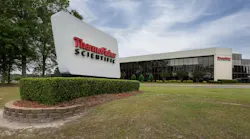
Thermo Fisher Scientific says it is well positioned in 2026 and over the next couple of years to capitalize on the Trump administration’s push to reshore drug manufacturing to the United States, as Big Pharma companies roll out hundreds of billions of dollars in domestic capital expenditures on new and existing production facilities.
“What you’re seeing with the administration’s policies is there’s real economic benefits to produce in the United States and create more jobs and supply chain resiliency,” CEO Marc Casper told investors at the Morgan Stanley Global Healthcare Conference on Tuesday. “The activity that it’s spurring is really in three different ways.”
Casper said that Thermo Fisher’s pharma services business, one of the world’s largest contract development and manufacturing organizations (CDMOs), has benefited this year from reshoring by biopharma customers — a trend he sees continuing in the quarters ahead.
“To meet the U.S. government’s requirements, [customers] can sign CDMO contracts — you don’t have to build a factory, you can just commit to U.S. production,” Casper said. “We’ve secured a number of large contracts for our capability to produce in the U.S. And in fact, in March of this year, President Trump visited our CDMO site in Cincinnati, one of the beneficiaries of those jobs moving back to the U.S., where we have a very high-tech facility in the oral solid dose category.”
Expanding its CDMO capacity
Casper contends that Thermo Fisher has invested in expanding its CDMO capacity to support customers’ U.S. production needs as government policies continue to drive reshoring. He highlighted biopharma customers’ needs for near-term capacity for both clinical and commercial manufacturing at Thermo Fisher’s domestic CDMO sites in the interim, enabling seamless tech transfer in the future to ensure the smooth transition and workflow replication to planned customer facilities.
Customers “might have produced those medicines somewhere else,” Casper added. “They sign a contract with us, we tech transfer, and we start to create jobs — it creates more growth for us.”
Last year, Thermo Fisher acquired a Sanofi sterile drug product manufacturing facility in Ridgefield, New Jersey — which is now part of Thermo Fisher’s pharma services business — which specializes in fill‑finish and packaging of aseptic injectable medications, expanding the company’s U.S. capacity for customers’ reshoring efforts.
“We have a strong position in drug product, which is primarily our sterile fill-finish business,” Casper said, calling it a “nice growth” area in 2027 and 2028.
As Big Pharma build and scale new sites and labs in the U.S., Casper highlighted customers’ needs for design, validation, and products for end-to-end workflow at their planned facilities, as well as expansions of existing facilities.
“They’re buying equipment, they’re moving medicines into the U.S.,” he observed. “You’ll see the one-time demand for that equipment. You’ll see the one-time demand to stock labs or stock supplies. You’re seeing activity pick up there and that’s probably more of a 2027 timeframe when it really steps up.”
Casper noted that most of Big Pharma’s hundreds of billions of dollars in domestic capital expenditure announcements involve “brand-new facilities — the greenfields that are being built.” These large companies are buying the necessary equipment from Thermo Fisher for “the inventory to get those facilities up and running — and that should be a 2027, 2028 type timeframe in terms of when that plays out,” he added.
When it comes to Thermo Fisher’s pharma services in the near term, Casper said he expects the business in the second half of 2026 to “see a nice step-up from the first half, and the activity supports that in terms of the contracts and the shipment schedule.”
Bioproduction on the rise
Thermo Fisher is targeting the growing bioproduction market, which spans the full cycle from cell culture media and single-use technologies — including its DynaDrive single-use bioreactor platform — to filtration, purification, and production chemicals. This comprehensive offering of bioproduction equipment, reagents, and consumables is being leveraged for the planned operations of new U.S. manufacturing sites, according to Casper.
“We have a drug substance business where we’re one of the largest of the single-use technologies producer of biologics,” Casper said.
In 2025, Thermo Fisher paid $4.1 billion in cash to buy Solventum’s purification and filtration business, whose technologies are used in the development and manufacturing of biologics spanning upstream and downstream workflows. The acquisition of Solventum is meant to better address the needs of Thermo Fisher’s customers who are currently underserved in the bioprocessing filtration segment, according to the company.
Thermo Fisher offers end-to-end bioproduction workflow of integrated solutions, including cell line development, single-use systems, chromatography, filtration, and purification. In April 2026, at Thermo Fisher’s Plainville, Massachusetts site, the company opened its flagship U.S. Bioprocess Design Center, a new facility where the company plans to work side by side with pharma and biotech customers to accelerate drug development and optimize manufacturing processes, enabling initial bioproduction workflow validation.
Casper argues the company’s advanced bioproduction technologies and instrumentation will enable new investments in U.S. biopharma manufacturing.
“The way that customers buy in the bioproduction segment is a best-in-breed approach, meaning that they will optimize the various technologies to produce their medicine,” he concluded. “The demand it will drive for life science tools and pharma services; it really is an outstanding neighborhood to live in.”
About the Author
Greg Slabodkin
Editor in Chief
As Editor in Chief, Greg oversees all aspects of planning, managing, and producing the content for Pharma Manufacturing’s website and digital products, as well as the daily operations of its editorial team.
For more than 20 years, Greg has covered the healthcare, life sciences, and medical device industries for several trade publications. He is the recipient of a Post-Newsweek Business Information Editorial Excellence Award for his news reporting and a Gold Award for Best Case Study from the American Society of Healthcare Publication Editors. In addition, Greg is a Healthcare Fellow from the Society for Advancing Business Editing and Writing.
When not covering the pharma manufacturing industry, he is an avid Buffalo Bills football and Buffalo Sabres hockey fan, likes to kayak, and plays guitar.