US biomanufacturing investment gains momentum as output rises: report
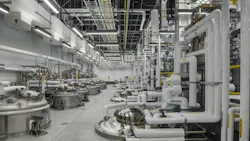
Driven by more than $500 billion in domestic biomanufacturing investment planned by Big Pharma, U.S. industrial production growth is expected to accelerate over the next few years, contends global commercial real estate advisory and services firm Newmark.
Pharma manufacturing production remains elevated as these investments expand, according to Newmark’s 1Q26 U.S. Life Science Market Conditions & Trends report, which notes that output rose 19.3% cumulatively from March 2018 through March 2026.
“The industrial production of pharmaceuticals and medicine, which measures the real output of U.S.-based establishments, ended 1Q26 above the long-term average,” states the report. “Based on recent announcements, pharmaceutical companies have committed upwards of $500 billion to U.S.-based manufacturing and research infrastructure over the past year. As a result, industrial production growth should improve over the next several years.”
With Big Pharma’s planned U.S. investment, Newmark said biomanufacturing employment is improving fueled by a “resurgence” in domestic drug manufacturing, which is pushing employment in the sector to a 30-year high.
“Biomanufacturing is one of the most significant green shoots in the U.S. life science market, as billions of dollars of capital has been committed to the onshoring of pharmaceutical production in recent months,” states the report.
Capital investment in domestic biomanufacturing is rising rapidly, according to Newmark, which said that biomanufacturing now accounts for more than 40% of capital expenditures — outpacing all other sectors by a wide margin in 2025 including automotive/transportation, energy, and high-tech/digitalization.
In January 2026, Newmark issued a separate report noting that with pledged investment up 20% since 2024, the biomanufacturing boom in the U.S. is just beginning.
“Policy shifts, tariff uncertainty and efforts to strengthen the resilience of domestic pharmaceutical supply chains have sparked a wave of U.S. production facility announcements,” the report stated.
Tariff relief brings Big Pharma to negotiating table
President Donald Trump has been pushing to impose Most Favored Nation (MFN) drug pricing and onshoring of pharmaceutical manufacturing on Big Pharma, striking deals with scores of large pharmaceutical companies in exchange for tariff exemptions.
Tariffs and geopolitical disruption are reshaping global pharmaceutical supply chains, according to a recent report by data and analytics firm GlobalData, which called out the Trump administration’s policy emphasis on incentives linked to domestic manufacturing and drug pricing agreements with large pharma companies that have resulted in commitments of tens of billions of dollars to expand their U.S. production capacities.
“The addition of geopolitical tension to the U.S. push to onshore pharma manufacturing will increase pressure on companies to rewire supply chains and production strategies, while also forcing them to evaluate the real-world effects of extraordinary trade policy changes,” Edita Hamzic, healthcare analyst at GlobalData, said in a statement.
Newmark’s report warns that with more than 70% of active pharmaceutical ingredients used in the U.S. produced overseas, the global supply chain remains vulnerable.
Still, the firm said the silver lining is that companies “heavily front-loaded imports” during the first quarter of 2025 to help mitigate the risk of tariffs, while MFN rates from the Trump administration “seem to be settling” at 15% for the European Union, Japan, and Korea — far below the 100% to 200% rates previously discussed.
About the Author
Greg Slabodkin
Editor in Chief
As Editor in Chief, Greg oversees all aspects of planning, managing, and producing the content for Pharma Manufacturing’s website and digital products, as well as the daily operations of its editorial team.
For more than 20 years, Greg has covered the healthcare, life sciences, and medical device industries for several trade publications. He is the recipient of a Post-Newsweek Business Information Editorial Excellence Award for his news reporting and a Gold Award for Best Case Study from the American Society of Healthcare Publication Editors. In addition, Greg is a Healthcare Fellow from the Society for Advancing Business Editing and Writing.
When not covering the pharma manufacturing industry, he is an avid Buffalo Bills football and Buffalo Sabres hockey fan, likes to kayak, and plays guitar.