Radiopharma industry poised to reach inflection point over next few years
The field of radiopharmaceuticals is undergoing a transformation that could lead the “niche” modality to gain more mainstream adoption over the next couple of years, becoming a “centerpiece” of cancer treatment, according to William Blair analysts.
Over the next three to five years, the analysts see the radiopharmaceutical industry as one of the most compelling secular growth opportunities in biotechnology. In 2025, they contend the sector attracted significant investment as radiopharma companies received roughly $900 million in private financings — with 2026-2027 shaping up as a “pivotal” time.
William Blair continues to see growing investor and biopharma interest in the radiopharmaceutical space. Big Pharma companies such as AstraZeneca, Bristol Myers Squibb, Eli Lilly, and Novartis are acquiring radioisotope supply and manufacturing capacity for radiopharmaceuticals. Last month, Regeneron signed a deal with Telix to co-develop therapies, tapping Telix’s radiopharma development and manufacturing expertise.
“We are optimistic that the recent resurgence in investor and Big Pharma interest that culminated in four high-profile acquisitions (Point Biopharma by Eli Lilly, RayzeBio by Bristol Myers, Fusion Pharma by AstraZeneca, and Mariana Oncology by Novartis), coupled with Novartis’s recent increase in Pluvicto peak sales guidance (to $5 billion, from $3 billion previously), will continue to drive investment in the field,” William Blair analysts wrote.
CDMOs scale up to meet demand
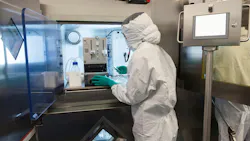
With scores of therapeutic radiopharmaceuticals currently in clinical trials, many will reach commercialization in the coming years and manufacturers are focused on providing facilities that are uniquely designed to meet the challenges of radiopharma manufacturing including handling radioactive materials safely.
The rapidly evolving field includes companies advancing therapeutic and diagnostic assets, as well as isotope producers and contract development and manufacturing organizations (CDMOs) with specialized infrastructure in handling radiopharmaceuticals that are boosting production capacity to meet growing market demand.
Last week, William Blair hosted a virtual one-day radiopharmaceutical conference that included presentations from radiopharma companies in the therapeutic, diagnostic, and CDMO spaces.
Among the companies that participated in the William Blair event was nuclear medicine company Curium, which last year announced it completed the acquisition of Nucleis — a specialist in GMP manufacturing and distribution of positron emission tomography (PET) radiopharma drugs — and separately acquired Monrol to expand manufacturing capacity for the medical isotope Lutetium-177.
Curium operates two manufacturing sites in the United States — Maryland Heights, Missouri and Noblesville, Indiana — as well as facilities in Austria Finland, France, and The Netherlands.
Late last week, Bloomberg reported that Curium has made a buyout offer worth $7 billion for radiopharmaceutical company Lantheus Holdings. In January 2025, Lantheus announced plans to acquire radiopharma CDMO Evergreen Theragnostics in an all-cash deal valued at $250 million, with up to $752.5 million in potential milestone payments.
The acquisition, completed in April 2025, bolstered Lantheus’ capabilities as a fully integrated radiopharma company by incorporating Evergreen’s scalable radioligand therapy (RLT) manufacturing infrastructure, which includes a revenue-generating CDMO business.
Need for specialized CDMOs
The complex nature of manufacturing radiopharmaceuticals, a class of drugs containing radioactive isotopes which require just-in-time delivery due to their short shelf lives, has led to a surge in demand for specialized CDMOs with capabilities in handling these sensitive materials and adhering to strict regulations for ensuring safety and quality.
CDMOs with capabilities in handling radiopharmaceuticals are seeing strong demand, reflecting growth in these therapeutic modalities. However, CPHI has warned that “barriers to entry here are extremely high and could lead to a supply/demand imbalance in the near term as more radiopharmaceuticals make their way into the clinical pipelines.”
Trying to get ahead of this, CDMOs and isotope producers are scaling up production capacity to meet the growing market demand.
Last month, Florida-based CDMO PharmaLogic opened a new PET radiopharmaceutical manufacturing facility in Atlanta, Georgia. The site is designed to expand domestic production capacity for diagnostic and therapeutic radiopharmaceuticals, while supporting research and development of next-generation products. In 2025, PharmaLogic acquired a majority stake in Norway-based Agilera, one of two CDMOs reportedly producing radiotherapeutics at commercial scale.
Last week, medical radioisotope producer Niowave broke ground on a new $75 million production facility in Lansing, Michigan that will expand domestic supply of Actinium-225 used in targeted alpha therapy for cancer treatment. The facility, Niowave’s second dedicated manufacturing site in Lansing, will feature multiple proprietary superconducting linear accelerators along with processing and quality systems for Ac-225 production.
In February, Niowave signed a long-term agreement to provide Novartis with a scalable supply of Ac-225 to support its growing portfolio of radioligand RLTs.
Novartis RLT manufacturing network
Critical questions facing the RLT space center around if they can be manufactured, released, and delivered at scale with manufacturing reliability as critical as clinical efficacy. Manufacturers must manage radionuclide supply, radiolabeling, quality testing, batch release, and logistics — with each step requiring precise execution and careful coordination to ensure a therapy reaches patients in a timely manner.
One company that is spearheading that effort is Novartis, which in April 2025 announced a $23 billion investment in U.S.-based infrastructure over five years and central to that strategy is building a distributed network designed around speed and proximity.
The Swiss drugmaker is advancing RLTs for various cancer types, including breast, brain, colon, lung, pancreatic, and prostate, supported by a coast-to-coast RLT manufacturing network in the U.S.
“Radioligand therapy is transforming how we treat cancer, and expanded manufacturing is essential to delivering these therapies at scale,” Novartis CEO Vas Narasimhan said in a statement.
Earlier this month, Novartis broke ground on a 46,000-square-foot RLT manufacturing facility in Denton, Texas, expanding the company’s U.S. network for production of targeted cancer therapies. The Texas site will become Novartis’ fifth U.S. radioligand therapy manufacturing facility and is expected to begin operations in 2028.
Construction is now underway across all planned new U.S. facilities. Together, these new sites will complement Novartis’ existing network in Millburn, New Jersey, Indianapolis, Indiana, and Carlsbad, California — all of which are expanding their RLT manufacturing capabilities.
About the Author
Greg Slabodkin
Editor in Chief
As Editor in Chief, Greg oversees all aspects of planning, managing, and producing the content for Pharma Manufacturing’s website and digital products, as well as the daily operations of its editorial team.
For more than 20 years, Greg has covered the healthcare, life sciences, and medical device industries for several trade publications. He is the recipient of a Post-Newsweek Business Information Editorial Excellence Award for his news reporting and a Gold Award for Best Case Study from the American Society of Healthcare Publication Editors. In addition, Greg is a Healthcare Fellow from the Society for Advancing Business Editing and Writing.
When not covering the pharma manufacturing industry, he is an avid Buffalo Bills football and Buffalo Sabres hockey fan, likes to kayak, and plays guitar.