Manufacturing of new FDA-approved drugs moving to China: GlobalData
Despite geopolitical tensions between Washington and Beijing, biopharmaceutical companies are increasingly choosing to manufacture their newer FDA-approved innovator and biosimilar products at facilities in China, according to an analysis by data and analytics firm GlobalData.
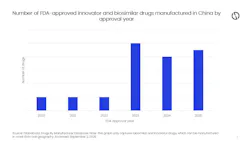
“The FDA-approved products currently being manufactured in China in 2026 includes two innovators and biosimilars that were approved in each year from 2020 through 2022,” Katia Djebbar, pharma analyst at GlobalData, said in a statement. “That number increased five-fold to 10 products approved in 2023, representing just under 7% of innovators and biosimilars approved by the FDA that year.”
While 2023 was the peak year, Djebbar noted that products approved by the FDA in 2024 and 2025 were “broadly consistent with the increased use of Chinese manufacturing facilities by biopharma companies.” Though the overall numbers are still low, she pointed out that the share of FDA-approved innovator and biosimilar products whose manufacturing mix included a facility in China rose from approximately 1.8% between 2020 and 2022 to an average of 6.7% between 2023 and 2025.
GlobalData contends the recent trend demonstrates growing confidence by the biopharma industry in using China for manufacturing, with U.S.-based companies accounting for more than half of the companies choosing Chinese facilities in 2026 as a production location for innovator and biosimilar drugs approved by the FDA between 2020 and 2025.
The firm called out Johnson & Johnson which outsourced the active pharmaceutical ingredient (API) manufacturing of its monoclonal antibody Imaavy (nipocalimab-aahu) to WuXi Biologics, adding that approximately 21% of these drugs are outsourced to the China-headquartered contract development and manufacturing organization (CDMO) which specializes in the API and dose manufacturing of proteins and peptides.
“Monoclonal antibodies account for the majority of WuXi Biologics’ contracts, including GSK’s Jemperli (dostarlimab), which generated cumulative revenue of $1.9 billion by the end of 2025, according to GlobalData’s Sales and Forecast Database,” Djebbar said. “A dual-location strategy followed by J&J for Imaavy (its API produced in China and the U.S.) and GSK with Jemperli (API production handled by sites in China and Ireland) could be the way forward.”
Last week, WuXi Biologics announced that its drug substance and drug product manufacturing facilities at the company’s Wuxi Mashan site in China successfully passed a two-week GMP inspection conducted by the FDA. The inspection covered multiple FDA-approved products including monoclonal antibodies, bispecific antibodies, fusion proteins, and enzyme products.
China’s WuXi AppTec
All of this comes as the U.S. has “taken steps to counter the growing appeal” of China-based manufacturing, according to GlobalData, which noted that Chinese contract manufacturer WuXi AppTec in June 2026 was designated as a “Chinese military company” by the Department of Defense (DoD) under Section 1260H of the BIOSECURE Act.
“Although the designation was subsequently blocked in August 2026, the episode highlights a potential pathway for U.S. policymakers to target and limit reliance on Chinese CDMOs and their supply chains,” GlobalData warns.
In Merck’s 2026 annual report, the drugmaker revealed it has “significant research and manufacturing operations” in China, including working with Chinese CDMOs such as WuXi AppTec, and that “if geopolitical tensions were to increase and disrupt the company’s operations in China, such disruption could result in a material adverse effect.”
From WuXi AppTec’s perspective, business is good despite being targeted by DoD. Last month, the company reported strong financial results for the first half of 2026 and raised its full-year guidance, while increasing its capital expenditure for infrastructure investments — including initiation of its new API site in Changzhou ahead of schedule.
Lilly’s investment in China
At the same time, U.S.-based biopharma companies are investing in their own Chinese infrastructure. Eli Lilly is making major manufacturing investments in China to build a localized and more resilient supply chain for its medicines aimed at creating a geographically diversified production network.
Lilly’s total investment in China has reached nearly $6 billion, including $3 billion over the next decade to build a localized manufacturing and supply network for its GLP-1 drugs. As part of its capital expenditure plans, Lilly is investing in its oral solid dosage production capacity in Beijing and expanding operations at its existing site in Suzhou.
“Ultimately, biopharma companies will need to assess where to manufacture their newer, FDA-approved drugs if the U.S. continues to tighten measures aimed at onshoring pharmaceutical supply chains,” GlobalData’s Djebbar concluded. “The U.S., pharma’s largest single-country market, and China, pharma’s second-largest single-country market, both need reliable supplies.”
About the Author
Greg Slabodkin
Editor in Chief
As Editor in Chief, Greg oversees all aspects of planning, managing, and producing the content for Pharma Manufacturing’s website and digital products, as well as the daily operations of its editorial team.
For more than 20 years, Greg has covered the healthcare, life sciences, and medical device industries for several trade publications. He is the recipient of a Post-Newsweek Business Information Editorial Excellence Award for his news reporting and a Gold Award for Best Case Study from the American Society of Healthcare Publication Editors. In addition, Greg is a Healthcare Fellow from the Society for Advancing Business Editing and Writing.
When not covering the pharma manufacturing industry, he is an avid Buffalo Bills football and Buffalo Sabres hockey fan, likes to kayak, and plays guitar.