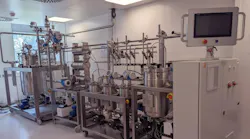
Consortium demonstrates continuous manufacturing platform for APIs
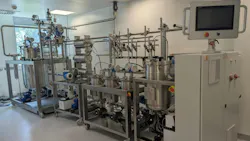
A European consortium has designed a continuous manufacturing platform for active pharmaceutical ingredients (APIs), using fentanyl to test an approach aimed at supporting more flexible production and reduce reliance on centralized manufacturing.
Members of the Europe-based consortium PIPAc — composed of four life science technology providers: De Dietrich, Alysophil, Bruker, and Novalix — co-developed the new platform and launched a pilot program that successfully validated its ability to continuously manufacture fentanyl.
The platform combines continuous flow chemistry, real-time analytical monitoring, and AI-driven process control. The integrated system measures process conditions and uses AI to adjust operating parameters. The pilot was critical to PIPAc’s mission of identifying new ways to enable domestic supply-chain resilience and reduce dependence on the centralized production of pharmaceutical ingredients following years of geopolitical uncertainty and disruption.
“For decades, pharmaceutical manufacturing has relied on production models that were designed for a different era,” says Frédéric Guichard, group executive director of De Dietrich. “Today, the industry faces new challenges: supply chain resilience, production sovereignty, faster industrialization and greater flexibility. PIPAc demonstrates that it is possible to rethink how pharmaceutical ingredients are manufactured.”
Building the platform
Through this pilot, PIPAc — short for Production Intelligente de Principes Actifs — demonstrated how the partners’ technologies could work together in a closed-loop continuous manufacturing system.
Novalix designed and implemented the platform’s continuous flow synthesis route; Bruker contributed analytical capabilities that enabled continuous measurement and monitoring; Alysophil developed an autonomous AI-driven process-control platform to analyze production data; and De Dietrich developed the industrial hardware platform and automation architecture.
Selecting a suitable synthetic route was a critical first step in determining whether the platform could be applied to a particular API.
After deciding between several APIs for the pilot, PIPAc selected fentanyl, in part because of shortages of the API in Europe during the pandemic and its suitability for continuous flow chemistry. It was also deliberately selected because it’s an extremely potent and highly controlled substance, says Julien Marin, senior vice president and COO at Novalix.
The industrial-scale demonstration of the pilot focused on fentanyl’s final synthetic step, rather than the full production process. The consortium demonstrated continuous production at multi-kilogram scale, using inline nuclear magnetic resonance (NMR) to monitor the process and AI-based control to adjust reactant flow rates. Marin emphasized that material produced during the trials was analyzed and then destroyed; the goal was to validate the platform’s integrated technologies, not to establish commercial fentanyl production.
PIPAc aimed to assess whether the platform could improve safety by design, reduce environmental impact, facilitate scale-up and improve manufacturing performance through AI-driven process control. Additionally, given the potency of fentanyl, the pilot was able to determine that the process could be operated and monitored remotely.
Also significant to the pilot was that the continuous manufacturing platform operated using smaller, modular production units, which demonstrated its ability to enable decentralized manufacturing strategies and support regional pharmaceutical production capabilities.
“With continuous manufacturing, you have compact and kind of modular units, which gives the possibility of putting the production closer to the point of need and changing capacity more dynamically than with a conventional large, centralized plant,” Marin says.
The path to GMP production
The pilot also demonstrated a foundation for future GMP-compatible continuous manufacturing systems, PIPAc contends.
“The platform can be expanded to incorporate downstream processing operations such as filtration, purification and drying, creating a pathway towards fully integrated pharmaceutical production,” according to the consortium.
However, Marin stressed that it could take up to two years to take a new molecule from the initial process assessment to a production unit ready.
It all begins with validating the chemistry at lab scale and then defining the most appropriate analytical technology and process control strategy.
After chemistry validation and then selecting analytical technology and process-control strategy, basic engineering begins, Marin says. This allows the team to develop initial CapEx and OpEx estimates. Meanwhile, the team generates experimental data, builds a digital twin and trains and selects AI agents for process control.
“We then move to the pilot scale validation, which is a critical step because this is where we validate that the complete process works at a relevant scale before committing to the final industrial design,” Marin added. “Once that milestone has been successfully passed, we can move into detailed engineering and construction of a production unit, followed by all qualification steps and commissioning.”
Before all of this, however, a feasibility assessment of the molecule is necessary to determine its suitability for the platform.
“The customer shares all the information available, including the specifications and the anticipation of the production volumes,” Marin says. “And then, based on that, Novalix evaluates the possible synthesis strategies and determines whether we can design a viable continuous flow process. This is quite easy and fast and takes less than a month. Once we have established the feasibility, we move into chemical processes and PAT development.”
Learning from disruption
The concept for the platform — and the inception of PIPAc itself — stems from a conversation that Marin and Alysophil President Philippe Robin had during the COVID-19 pandemic about the fragility of global pharma supply chains.
“At the time, there was a renewed focus on pharmaceutical sovereignty and the need to increase local API production,” says Marin. “With Philippe, we shared the conviction that pharmaceutical manufacturing could be made more flexible, more local, and more responsive by bringing together some breakthrough technologies like continuous flow for chemistry, inline analysis, and physical AI.”
This prompted an initial idea to create a platform that would be developed using Novalix’s continuous flow synthesis route and Alysophil’s autonomous AI-driven process-control platform. But to successfully build the platform, Novalix and Alysophil needed to round out their project with organizations that could provide a hardware platform and additional analytical capabilities, which led to the addition of De Dietrich and Bruker, thereby completing the consortium.
Identifying an alternative to traditional batch manufacturing was another impetus that drove the creation of the platform.
“Unlike traditional batch production, continuous manufacturing allows product quality and process performance to be assessed throughout production, enabling earlier intervention, reduced scale-up risk and more efficient use of resources,” the consortium says.
However, Marin stressed that continuous manufacturing should not be seen as a replacement for batch manufacturing, but rather as an alternative that best suits certain synthetic routes.
“From my point of view, the right choice depends on the chemistry, the scale, the production profile, and also the already existing manufacturing footprint, the supply chain, the criticality of the API, and ultimately the strategy of a manufacturer,” he argues. “If we focus on the technological criteria, continuous processing becomes particularly attractive when tight control of reaction conditions really matters. Because when doing continuous flow, only a relatively small quantities of chemicals are present in the reactor at any given time, so flow can offer inherent safety advantages, as well as very efficient heat and mass transfer.”
About the Author
Andy Lundin
Senior Editor
Andy Lundin has more than 10 years of experience in business-to-business publishing producing digital content for audiences in the medical and automotive industries, among others. He currently works as Senior Editor for Pharma Manufacturing and is responsible for feature writing and production of the podcast.
His prior publications include MEDQOR, a real-time healthcare business intelligence platform, and Bobit Business Media. Andy graduated from California State University-Fullerton in 2014 with a B.A. in journalism. He lives in Long Beach, California.