Pharma shift to biologics, away from small molecules impacts manufacturing
The pharmaceutical market is making a fundamental shift toward biologics, and away from small molecules, which will have profound implications for manufacturing over the coming decade. For the first time, biologics in development outnumber small molecules — according to Citeline’s Pharma R&D Annual Review 2026 — which describes the milestone as a tipping point for the industry.
Citeline noted a surge in the numbers of antibody-drug conjugates in development, which grew more than 30% over the 2025-2026 period. While monoclonal antibodies are expected to dominate the market, almost all subtypes of biologics are predicted to grow significantly over the next several years.
At Thermo Fisher’s 2026 Investor Day last month, CEO Marc Casper said the biomanufacturing market is strengthening due to reshoring trends, rising biotechnology investment, as well as growth in biologics and complex modalities.
“What you see is a larger focus on biologics versus small molecules,” Casper said. “Biologics are much more life science tools- and pharma services-intensive than small molecule. So that simple shift of what’s in the pipeline drives demand to our industry.”
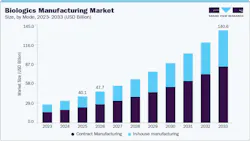
The global biologics manufacturing market was valued at $40.1 billion in 2025 and is expected to reach $140.6 billion by 2033, growing at a compound annual growth rate (CAGR) of 16.7% between 2026 and 2033, according to a report from Grand View Research.
The robust growth is primarily driven by increasing demand for biopharmaceuticals, expansion of biologics production capacities, and advancements in cell and gene therapy manufacturing technologies, the firm contends. However, the contract manufacturing segment accounted for the largest market share in 2025 and is expected to experience the fastest CAGR during the forecast period.
Pharma and biotech companies are turning to contract development and manufacturing organizations (CDMOs) “due to the growing pipeline of complex biologics, the need for large-scale, cost-effective production, and specialized infrastructure, knowledge, and regulatory compliance,” Grand View Research said, while adding CDMOs are “becoming more widely used in biologics production by increasing their capacity, global reach, and use of cutting-edge technologies like continuous bioprocessing and single-use systems.”
CDMOs are also moving beyond traditional large-scale antibody production to offer capabilities in cell and gene therapies, viral vectors, and specialized fill-finish services, the report said, with the cell and gene therapy segment anticipated to grow at the fastest CAGR between 2026 and 2033.
Complexity of manufacturing biologics
While the biologics market is experiencing strong growth, particularly antibody-derived biologics, it also poses significant manufacturing challenges for manufacturers. Compared to small molecules, biologics manufacturing requires more planning, investment, and a multi-disciplinary workforce, according to the American Chemical Society’s CAS division.
“Biologics are generally less robust than small molecules; they are both light and temperature-sensitive and more prone to shearing and degradation,” CAS said in a white paper. “Manufacturing biologics requires highly engineered specialized equipment to minimize challenges as the therapy moves from discovery to commercialization.”
Companies are increasingly expanding their cold storage facilities or depending more on “white-glove” and highly specialized cold chain service providers, as they scale up domestic manufacturing operations, particularly for biologics, cell and gene therapies, and other temperature-sensitive modalities, according to a report from commercial real estate advisory and services firm Newmark.
“As production volumes grow, users require more refrigerated and freezer storage capacity near their manufacturing lines,” the report states. “Many companies are co-locating these expanded cold storage assets in markets where the life sciences sector is already concentrated, as well as emerging markets reacting to the increase in manufacturing facilities.”
Unlike small molecule therapeutics, biologics are not chemically synthesized but are cultivated within living systems such as microorganisms or plant or animal cells — produced through biological processes that lead to batch-to-batch variability.
As a result, biologics are much more complex than small molecule drugs — sometimes by an order of magnitude of 1,000 times in size — and are produced through specialized, proprietary biological processes, according to a National Institutes of Health (NIH) document on manufacturing scale-up of drugs and biologics.
“Drugs generally require fewer critical process steps than biologics, which undergo numerous essential stages of their synthesis and production,” NIH notes. “The scale-up from laboratory to commercial production for biologics is a delicate operation that demands substantial investment and a high degree of precision — any error could result in significant setbacks or complete failure.”
Grand View Research called out the fact that pharma and biotech companies are making significant investments in their research pipelines to launch new biologic therapies to provide targeted and efficient treatment options for complex illnesses, such as diabetes, cancer, autoimmune diseases, and cardiovascular conditions. At the same time, the firm said the biologics fill-finish manufacturing market is gaining momentum as companies focus on enhancing precision, sterility, and speed in the final stages of drug production.
“The industry is expanding due to a high level of innovation in the manufacturing process, improvements in bioprocessing technologies, single-use systems, automation, and digital controls, which allow for increased productivity, scalability, and product quality,” according to the report. “The range of biologics is also growing, ranging from customized cell and gene therapies to next-generation monoclonal antibodies, thanks to advancements in formulation and delivery techniques.”
Talent deficit remains major hurdle
Despite the recent wave of biomanufacturing investments, the sector faces a worsening 35% talent deficit that threatens to undermine expansion plans with 80% of manufacturers reporting critical skills mismatches, particularly in advanced manufacturing technologies.
Cytiva’s 2025 Global Biopharma Index found that skill shortages remain a significant challenge. In the biennial survey, 38% of executives reported severe or critical shortages in workers for fast-growing therapeutic areas — including antibody-drug conjugates, cell and gene therapies, and mRNA — with shortfalls in manufacturing staffing (27%).
Still, with Big Pharma’s planned U.S. investment, Newmark’s recent report found that biomanufacturing employment is improving fueled by a “resurgence” in domestic drug manufacturing, which is pushing employment in the sector to a 30-year high.
“Hiring appears to be improving but openings are concentrated in high-growth areas such as AI-driven drug discovery, cell and gene therapy and manufacturing,” Newmark said. “Demand for specialized talent remains strong, as these roles are not easily filled.”
Biopharmaceutical manufacturing at a crossroads
Outpaced by AI-accelerated drug discovery and clinical development, biomanufacturing has reached an inflection point in the production of increasingly complex biologics, according to a recent report from professional services firm Accenture.
Based on an analysis of FDA Complete Response Letters (CRLs), the report found that 64% of drug-launch delays were tied to chemistry, manufacturing and controls (CMC) issues, with many of those delays stemming from the production of biologics. Accenture highlighted the fact that biologics now represents 55% of the clinical pipeline, putting mounting pressure on manufacturers to modernize operations and scale production more efficiently.
At the same time, AI-driven drug discovery and clinical trials are compressing development timelines and increasing pressure on manufacturing and technical operations teams, the firm said. The report calls out the importance of advanced analytics, AI, digital twins, intelligent agents, and robotics in potentially helping manufacturers improve efficiency, reduce variability, and strengthen operational resilience.
“Data, AI and other intelligent technologies are already rewriting the rules across the industry,” according to Accenture. “As these capabilities advance, manufacturing has the potential to become a powerful engine for transformation rather than a limiting factor.”
About the Author
Greg Slabodkin
Editor in Chief
As Editor in Chief, Greg oversees all aspects of planning, managing, and producing the content for Pharma Manufacturing’s website and digital products, as well as the daily operations of its editorial team.
For more than 20 years, Greg has covered the healthcare, life sciences, and medical device industries for several trade publications. He is the recipient of a Post-Newsweek Business Information Editorial Excellence Award for his news reporting and a Gold Award for Best Case Study from the American Society of Healthcare Publication Editors. In addition, Greg is a Healthcare Fellow from the Society for Advancing Business Editing and Writing.
When not covering the pharma manufacturing industry, he is an avid Buffalo Bills football and Buffalo Sabres hockey fan, likes to kayak, and plays guitar.