WuXi XDC’s revenue grows 37% in H1 2026 fueled by ADCs, bioconjugates
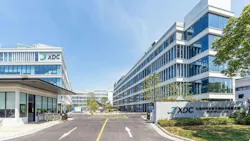
WuXi XDC Cayman, a Shanghai, China-headquartered contract research, development, and manufacturing organization (CRDMO) focused on bioconjugates, reported interim financial results for the first half of 2026 including 37% period-over-period revenue growth on an actual exchange rate basis.
The CRDMO said the increase was primarily attributable to the growth in the number of the company’s customers and projects, driven by continued active development of the global antibody-drug conjugate (ADC) and the broader bioconjugates market.
“Our strong first-half 2026 performance reflects the continued execution of our long-term strategy and increasing global demand for integrated bioconjugate CRDMO services,” Jimmy Li, CEO of WuXi XDC, said in a statement. “During the period, we further strengthened our capabilities through the successful integration of BioDlink, continued expansion of our global manufacturing network, and advancement of our proprietary technology platforms.”
In China, WuXi XDC’s manufacturing sites include Changzhou (payload-linker), Shanghai (bioconjugate discovery and process development), and Wuxi (drug substance/drug product). Last week, the company’s new Singapore site received Good Manufacturing Practice (GMP) release for its BCM3 dual-function production line, enabling commercial manufacturing of antibody intermediates and drug substances for bioconjugates.
The facility is the CRDMO’s first overseas GMP-released manufacturing line and BCM3 supports batch sizes of 200 liters to 2,000 liters for antibody intermediates and up to 2,000 liters for conjugated drug substances. The line will operate as part of WuXi’s network alongside its BCM1 and BCM2 lines in Wuxi. A BCM4 production line in Singapore, with up to 500 liters of bioconjugate drug substance per batch capacity, is expected to commence GMP manufacturing this year.
WuXi XDC maintains that as the company’s “global dual-sourcing” strategy continues to mature, its Singapore and Wuxi sites will integrate and “collaborate more deeply, building a comprehensive, multi-dimensional network that combines global service with local responsiveness.”
BioDlink integration in China
In March, WuXi XDC completed its acquisition of an approximately 60% stake in Suzhou, China-headquartered BioDlink, which specializes in biologics and bioconjugates and provides fully integrated, end-to-end services from early R&D through commercial manufacturing. The integration is meant to create greater value for customers across the bioconjugate development lifecycle.
As a controlled subsidiary of WuXi XDC, BioDlink — with centers in Shanghai and Beijing — operates four commercial manufacturing lines with large-scale sterile fill-finish capabilities, increasing WuXi’s manufacturing capacity in China, broadening its project portfolio, and expanding its customer network.
BioDlink’s proprietary technology platforms include BDKcell and GL-DisacLink. BDKcell is a cell line development platform that delivers high-expression performance in standard fed-batch processes across multiple biologic modalities. GL-DisacLink is a conjugation platform that simplifies ADC manufacturing through a streamlined enzyme-based conjugation approach.
In February, WuXi XDC and Earendil Labs entered an agreement valued at up to $885 million that gave the biotech company exclusive rights to WuXi’s proprietary WuXiTecan-2 payload-linker technology platform for multiple targets. Under the collaboration, Earendil is combining its AI-driven antibody discovery platform with WuXi’s integrated ADC development and manufacturing capabilities.
As an exatecan-based payload-linker platform, WuXiTecan-2 features “improved hydrophilicity, plasma stability, and robust in vivo efficacy,” according to WuXi XDC.
The company contends the technology has been successfully applied to three integrated chemistry, manufacturing, and controls (CMC) -stage customer programs via licensing agreements, with Earendil Labs and a European biotech company in 2026 demonstrating its “strong developability and translational potential.”
About the Author
Greg Slabodkin
Editor in Chief
As Editor in Chief, Greg oversees all aspects of planning, managing, and producing the content for Pharma Manufacturing’s website and digital products, as well as the daily operations of its editorial team.
For more than 20 years, Greg has covered the healthcare, life sciences, and medical device industries for several trade publications. He is the recipient of a Post-Newsweek Business Information Editorial Excellence Award for his news reporting and a Gold Award for Best Case Study from the American Society of Healthcare Publication Editors. In addition, Greg is a Healthcare Fellow from the Society for Advancing Business Editing and Writing.
When not covering the pharma manufacturing industry, he is an avid Buffalo Bills football and Buffalo Sabres hockey fan, likes to kayak, and plays guitar.