Halo Pharma targets sterile injectable manufacturing at Whippany, NJ site
2026 has been an eventful year for Halo Pharma. The New Jersey-based contract development and manufacturing organization (CDMO) got new wings earlier this year when it became a stand-alone business following the sale of Noramco’s active pharmaceutical ingredient (API) operations and related businesses to Siegfried.
With the divestiture of the API-related assets, Halo has refocused this year as a dedicated CDMO for drug product services, while last month the company launched its new $45 million sterile injectable manufacturing platform at their Whippany, New Jersey facility.
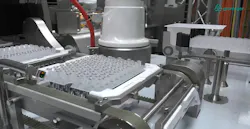
Halo built an aseptic manufacturing suite that features a sterile fill-finish platform including a high speed, 10-head Groninger UFVN FlexFill filling line and a SKAN isolator, designed to support clinical phases through commercial production.
“We’re finished with construction and we’re starting the qualification process and plan to be into GMP production before the end of the year,” CEO Lee Karras told Pharma Manufacturing. “We have a commercial product already. That’s going to be manufactured next year in the first quarter and then filed.”
“That should trigger an FDA inspection, and then once that inspection happens — assuming we get that product approved — we’ll be considered FDA-approved for commercial production,” Karras added. “Between now and then, we’re mainly going to be doing clinical and registration batches.”
Serving clinical and commercial
The Whippany facility will be able to manufacture batches ranging from 5,000 to 250,000 units, with an annual production capacity exceeding 50 million units. The Groninger filling line is built to handle 0.5–10 mL syringes, 2–30 mL vials, and 1–3 mL cartridges.
“Obviously, we don’t have change parts for all these sizes right now — we’ll get those and qualify them as we need to. Right now, we’re focused on the 2mL vials and 1mL syringes — that’s where we’re starting,” Karras said.
He emphasized that the Groninger filling line is meant to accommodate commercial quantities — which is the intention long term. He noted the line is “full isolator, so it’s not a conventional cleanroom” and claimed it is one of only two such lines in the U.S.
“Others have isolators, but this is a one-of-a-kind type thing and gives us a lot of aseptic control,” Karras said. “Because it’s a ready-to-use line, everything will be fed through tubs or trays — prewashed, presterilized, depariginated. It uses disposable technology as well so everything we use will be used once and then thrown away.”
Karras described Halo’s Whippany facility as a “plant within a plant” with its own airflow and HVAC at its already FDA-approved site for manufacturing oral solid dose, liquid formulations, and controlled substances — which this year has launched five new products for customers. “We’re established for other products, just not injectables right now,” he said.
Sterile injectables remain one of the fastest-growing segments in the pharmaceutical market, with capacity constraints contributing to ongoing drug shortages. The Halo expansion in Whippany is meant to support both branded and generic pharmaceutical customers, helping to reinforce U.S. domestic production of critical drugs.
“Many of the customers we work with today have injectable pipelines and so it’s a logical extension,” Karras said, while noting that “there’s been a lot of FDA focus on aseptic operations” with increased regulatory scrutiny of fill-finish facilities.
He called out the FDA’s recent classification of a Novo Nordisk site in Indiana as Official Action Indicated, emphasizing that Halo’s Whippany facility aligns with U.S. Good Manufacturing Practice (GMP) quality standards and EU Annex 1 requirements.
“There’s room for a high-quality, compliant, state-of-the-art new entrant to come into this space,” Karras added. “We’re going to focus on branded [pharmaceutical] companies, but we also will do some high value generics as well. One of the areas we’re focused on is narcotic syringes because they’ve been on the [FDA] drug shortage list almost perpetually. That’s an area that we’re working with a partner on right now.”
About the Author
Greg Slabodkin
Editor in Chief
As Editor in Chief, Greg oversees all aspects of planning, managing, and producing the content for Pharma Manufacturing’s website and digital products, as well as the daily operations of its editorial team.
For more than 20 years, Greg has covered the healthcare, life sciences, and medical device industries for several trade publications. He is the recipient of a Post-Newsweek Business Information Editorial Excellence Award for his news reporting and a Gold Award for Best Case Study from the American Society of Healthcare Publication Editors. In addition, Greg is a Healthcare Fellow from the Society for Advancing Business Editing and Writing.
When not covering the pharma manufacturing industry, he is an avid Buffalo Bills football and Buffalo Sabres hockey fan, likes to kayak, and plays guitar.