Outsourcing of new drug manufacturing continues to shift to Europe: GlobalData

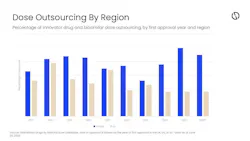
Biopharmaceutical companies are increasingly moving to outsource the manufacturing of new drugs to Europe, while the gap between the use of European and U.S. facilities continues to grow, according to a new analysis by data and analytics firm GlobalData.
“Outsourced dose manufacturing for innovator drugs and biosimilars approved in the U.S. and Europe (the EU and UK) has traditionally oscillated between the two geographies, but there has been a pronounced shift toward European facilities over the last two years,” the firm contends in its latest report.
The most recent full-year data show a growing gap between the use of European and U.S. facilities, with the first half of 2026 continuing that trend, according to an analysis based on GlobalData’s Drug By Manufacturer Database.
Last year, 50% of new drugs had dose manufacturing contracts with European-based facilities — almost doubling their share since 2023 — while that proportion for U.S.-based facilities has remained static at 18% since 2024, finds GlobalData.
The firm notes that in recent years Europe has continuously held its lead despite some fluctuations over the past decade, including instances when U.S.-based facilities came close to European outsourcing proportions in 2018, 2021, and 2023.
“National tax systems are one element supporting the growth in European contract manufacturing,” Katia Djebbar, pharma analyst at GlobalData, said in a statement. “Irish facilities accounted for 13% of the region’s dose manufacturing contracts in 2025, up from approximately 6% in 2024.”
Djebbar highlighted Ireland’s increase in its Research and Development (R&D) Corporation Tax Credit to 35% in January 2026, which is currently one of the most competitive rates in Europe. At the same time, she pointed to Germany — which contributed just over a fifth of European dose outsourcing for new drugs in 2025 — describing that country’s offering as a “generous R&D tax credit of 25-35%” while the U.S. offers companies an Alternative Simplified Credit of between 6% and 14%, depending on increases in R&D spending.
R&D tax credits are incentivizing contract development and manufacturing organizations (CDMOs) to advance production techniques and technologies, with the expansion of specialized facilities in Europe to support scalable commercial manufacturing for biosimilars. GlobalData noted that South Korea–based biosimilar developer Celltrion outsourced nine dose manufacturing contracts to European facilities in 2025 — up from seven in 2024 — as evidence of its reliance on specialized CDMO partners in Europe.
“Although dose outsourcing of newly approved drugs to the U.S. and Europe has fluctuated over the past decade, the gap between the two regions was at its widest in 2025, and 2026 looks set to extend that picture of biopharma’s strategic preference for European outsourcing facilities,” Djebbar concluded.
Contract manufacturing deals move to Europe
GlobalData reported earlier this year that contract manufacturing deals for drugs marketed in the U.S. are shifting to Europe, with biopharma companies increasingly choosing to outsource manufacturing to European facilities.
In 2025, U.S. contract manufacturing deals for FDA-approved drugs experienced their biggest decline in five years, according to the firm, which said the gap between U.S.- and Europe-based contract manufacturing deals was the widest yet with the EU securing more than triple the U.S. deal volume.
Last year, nine out of the 14 U.S.-based biopharma companies that outsourced manufacturing — including Johnson & Johnson and Vertex Pharmaceuticals — invested in a total of 13 Europe-based manufacturing deals, according to GlobalData. By comparison, the firm found less than half of these companies invested in U.S.-based facilities signing a total of eight contract manufacturing deals, despite the Trump administration’s imposition of tariffs on EU pharmaceuticals.
“The shift in manufacturing deals toward Europe highlights the limited impact that tariffs have had in steering biopharma companies away from European-based contract manufacturing,” Djebbar said. “Such a shift may hinder the current U.S. administration’s plans to reshore domestic contract manufacturing.”
About the Author
Greg Slabodkin
Editor in Chief
As Editor in Chief, Greg oversees all aspects of planning, managing, and producing the content for Pharma Manufacturing’s website and digital products, as well as the daily operations of its editorial team.
For more than 20 years, Greg has covered the healthcare, life sciences, and medical device industries for several trade publications. He is the recipient of a Post-Newsweek Business Information Editorial Excellence Award for his news reporting and a Gold Award for Best Case Study from the American Society of Healthcare Publication Editors. In addition, Greg is a Healthcare Fellow from the Society for Advancing Business Editing and Writing.
When not covering the pharma manufacturing industry, he is an avid Buffalo Bills football and Buffalo Sabres hockey fan, likes to kayak, and plays guitar.