Lifecore expects 2026 revenue to decline by 12%-15% due to customer-driven factors
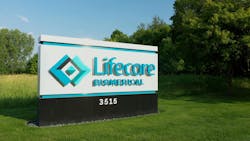
Minnesota-based contract development and manufacturing organization Lifecore Biomedical provided a corporate update on Monday that had investors running for the exits, with the company’s stock dropping more than 30%.
Lifecore expects 2026 revenue to decline by 12%-15% — a $17 million to $18 million revenue headwind — due to customer-driven factors including the anticipated loss of a customer due to a change in its supply strategy, lower hyaluronic acid revenue from a customer, as well as a commercial launch previously targeted this year that has been delayed due to a customer’s funding challenges.
The company also updated the expected commercialization window for its late-stage programs to 2027 through 2030, compared with the prior expectation of 2026 through 2029.
In a Monday earnings call, CEO Paul Josephs told analysts the “shifting of these timelines is not due in any way to Lifecore’s performance, capabilities, or capacities” and are out of the company’s control. However, Josephs said Lifecore remains “optimistic” that the 10 late-stage programs in its development pipeline “will continue to advance and have the potential to reach commercialization before or during 2030” and that even a modest conversion rate of 50% “could drive a significant increase in revenue in the years ahead.”
William Blair analysts in a Tuesday note called the update a “tough pill to swallow” for investors “considering 2027 was previously framed as the inflection point that would set Lifecore on the path to executing against its midterm outlook.” While there is still the potential for the company to hit its 2029 targets, the analysts wrote “it will take 25%-30% revenue growth in both 2028 and 2029 to get there.”
Positioned for future growth?
Despite Monday’s disappointing update, William Blair analysts contend that Lifecore is a “solid business that offers investors the opportunity to benefit from strong underlying trends in the form of healthy drug sales and strong demand for fill-finish capacity in the U.S.”
In January during the J.P. Morgan Healthcare Conference, Josephs told Pharma Manufacturing that there is clearly momentum in U.S. manufacturing.
“I used to think of site transfers as more tactical but now I think of it as more strategic,” Josephs said. “We’ve benefitted in large part either because of the regionalization of manufacturing or some compliance related activity with some of our competitors. We see that trend continuing.”
During Monday’s earnings call, Josephs emphasized Lifecore’s focus on regionalized manufacturing in the U.S. and the continued pursuit of site transfers in 2026, while noting that two commercial site transfers added in 2025 are expected to contribute commercial revenue within 24 months to 30 months.
Barrington Research analyst Michael Petusky wrote in a Tuesday note to investors that his firm believes 2028 — rather than 2027— will “represent the breakout year for Lifecore” with the expectation of “further long-term value creation via additional programs, including site transfer wins.”
Aseptic fill-finish capacity
Josephs touted Lifecore’s current and anticipated aseptic fill-finish capacity utilization, which he contends will help drive mid-term growth. In the last year, he said Lifecore utilized about 20% of its 45-million-unit capacity but expects utilization to increase to about 60% by 2029, as new programs scale and its minimum volume commitments with its largest customer go into effect in 2027.
“Our long-term plan is to fill the remaining unused capacity, which we expect will drive revenues to over $300 million,” Josephs added.
For now, Lifecore provided 2026 guidance with total revenue expected in the range of $120 million to $125 million. CFO Ryan Lake told analysts on Monday that the company anticipates generating “modest” revenue growth in 2027 with significant revenue growth continuing into 2028 “driven by expansion of existing customer programs, including a planned doubling of aseptic demand from our largest customer.”
Josephs pointed to Lifecore’s preparation for a significant increase in aseptic fill-finish demand from its largest customer starting in 2027, including the 2025 qualification of a five-head isolator filler to supply the European and Asian markets for the customer and the qualification of hyaluronic acid (HA) for the Japanese market.
“Meeting Japan’s strict HA specification requirements is difficult to achieve, and we believe our success in meeting this challenge speaks to our expertise and capabilities,” he said. “We believe that we are well positioned to support this critical expansion and financial inflection point.”
About the Author
Greg Slabodkin
Editor in Chief
As Editor in Chief, Greg oversees all aspects of planning, managing, and producing the content for Pharma Manufacturing’s website and digital products, as well as the daily operations of its editorial team.
For more than 20 years, Greg has covered the healthcare, life sciences, and medical device industries for several trade publications. He is the recipient of a Post-Newsweek Business Information Editorial Excellence Award for his news reporting and a Gold Award for Best Case Study from the American Society of Healthcare Publication Editors. In addition, Greg is a Healthcare Fellow from the Society for Advancing Business Editing and Writing.
When not covering the pharma manufacturing industry, he is an avid Buffalo Bills football and Buffalo Sabres hockey fan, likes to kayak, and plays guitar.