Trump tariff order pushes onshore drug manufacturing longer term: analysts
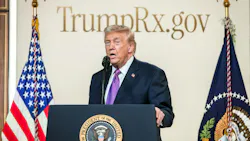
President Donald Trump signed an executive order imposing a 100% tariff on patented pharmaceutical products and ingredients imported to the United States, with some major exemptions. While Leerink Partners analysts see “no near-term material changes” to the U.S. onshoring narrative from the order, they contend it underscores the Trump administration’s sustained push to onshore drug manufacturing longer term.
“Exemptions and off-ramps are likely to bring the effective tariff rates well below the headline 100% but consistent pressure on onshoring could ultimately yield results — irrespective of who is in White House by 2029,” the analysts wrote in a note to investors, adding that the “tariff timelines raise questions on if the next administration will play along.”
Pharmaceutical companies with Most Favored Nation (MFN) drug pricing agreements with the Trump administration are exempt from the tariff. For companies that enter into MFN pricing agreements with the Department of Health and Human Services and onshoring agreements with the Department of Commerce, a 0% tariff will apply through January 20, 2029, according to the White House. For companies that only sign onshoring agreements with the Department of Commerce, a 20% tariff will apply.
“Tariffs on pharmas with approved onshoring plans starts at 20% and steps up to 100% on April 2030,” the Leerink Partners analysts said. “Similarly, pharmas with onshoring and MFN agreements have 0% rates until Jan 20, 2029, the inauguration of the next president. We believe onshoring has bipartisan support, though it’s uncertain if the future administration will want to use tariffs to accomplish this.”
The analysts made the case that recent comments from bioprocessing and contract development and manufacturing organization (CDMO) leaders at Leerink’s Foundations of Discovery, Drugs and Dx conference held last month “give us added conviction that the onshoring opportunity is real.”
The analysts cited comments by Catalent CEO Alessandro Maselli at last month’s conference that the onshoring opportunity is real but will take time.
“Maselli laid out that first comes tech transfer into existing empty capacity, then line additions within existing footprints,” the analysts wrote. “He said tech transfer can take 1-3 years, adding new lines and then tech-transferring into them is more like ~3 years, and a greenfield biologics facility is at least 5 years. This makes 2029-2030 the realistic window for when onshoring materializes.”
ADCs, peptides, and GLP-1s
According to the analysts, Maselli said demand is “molecule-dependent” and highlighting that larger-volume areas such as antibody-drug conjugates (ADCs), peptides, and cardiometabolic therapies are seeing better momentum, while “onshoring and tariff-related planning have also inflated some commercial demand near term.”
He also noted that CDMO demand is being driven by supply security concerns — particularly in areas such as peptides and GLP-1s — where capacity constraints have emerged.
“Maselli said clinical demand today is coming primarily from small molecules and proteins, including antibodies, bispecifics, and other established biologic formats, while mRNA continues to struggle and gene therapy has not fully sustained the promise many expected a few years ago,” according to the analysts. “He specifically called out a renaissance in small molecules, citing CNS, protein degraders, and oncology-related chemistry as attractive areas of current demand.”
Generic drugs and advanced modalities
For now, generic pharmaceutical products, biosimilars, and associated ingredients are not subject to the 100% tariff in Trump’s executive order announced late last week. However, the White House said the administration’s decision will be “reassessed” in one year.
While generics and biosimilars are currently exempt until further review in April 2027, Leerink Partners analysts said they “remain in the crosshairs” which suggests “continued interest in onshoring generics despite multiple industry players doubting the viability of doing so, particularly for small molecule generics.”
The analysts referenced comments by Maselli who argued that “large-scale reshoring of generics into the U.S. is far less likely because the economics are simply too difficult, with U.S. manufacturing costs likely making generics 30-40% more expensive in a healthcare system that is already under cost pressure.”
At the same time, the analysts said Maselli made the case that “innovative drugs are much more likely to be reshored because manufacturing cost is a much smaller percentage of drug price, making supply security and geopolitical resilience more important than minimizing [cost of goods sold].”
When it comes to specialty pharmaceutical products, such as orphan drugs and pharma for animal health, the White House in last week’s announcement said they will be exempt from tariffs “if they are from trade deal countries or meet an urgent public health need.”
Leerink Partners analysts noted that advanced modalities and rare disease drugs got exemptions under Trump’s executive order, including ADCs, cell and gene therapies (CGTs), and radiopharmaceuticals.
“The list of tariff exemptions suggests orphan products, CGTs, ADCs, radiopharmas will face less push for onshoring, though products like autologous CGT and radiopharmas are generally already manufactured near treatment sites,” the analysts said.
About the Author
Greg Slabodkin
Editor in Chief
As Editor in Chief, Greg oversees all aspects of planning, managing, and producing the content for Pharma Manufacturing’s website and digital products, as well as the daily operations of its editorial team.
For more than 20 years, Greg has covered the healthcare, life sciences, and medical device industries for several trade publications. He is the recipient of a Post-Newsweek Business Information Editorial Excellence Award for his news reporting and a Gold Award for Best Case Study from the American Society of Healthcare Publication Editors. In addition, Greg is a Healthcare Fellow from the Society for Advancing Business Editing and Writing.
When not covering the pharma manufacturing industry, he is an avid Buffalo Bills football and Buffalo Sabres hockey fan, likes to kayak, and plays guitar.