Vacuum Is a Process Variable: Key Considerations for Process Scale-Up
Key Highlights
- Proper vacuum pump selection requires evaluating performance under actual operating conditions, not just rated flow and ultimate vacuum.
- Successful scale-up depends on accounting for increased vapor loads, system volume, leaks, temperature and other changing process conditions.
- Matching vacuum controls and standardizing data collection across scales helps maintain process efficiency, consistency and reliability.
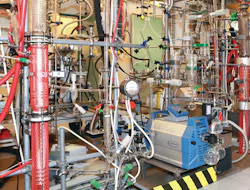
A solvent removal step performs reliably at the bench. The operating vacuum is stable and evaporation proceeds as expected. When the same operation moves to a larger reactor, rotary evaporator, distillation apparatus, or drying system, performance changes. Pump-down takes longer, system pressure rises under load, the unit operation becomes a bottleneck. At scale increased vapor loads and larger systems can expose limitations that were not apparent at the bench.
Vacuum pumps are not a one-size-fits-all tool. Proper pump selection is crucial for maintaining reliable process conditions and selecting a pump on its rated flow and ultimate vacuum alone is not a reliable scale-up strategy.
Look Beyond Rated Pump Performance
Vacuum pumps are rated based on their ultimate, or deepest, achievable vacuum and their maximum flow rate which is typically achieved at or near atmospheric pressure. Ratings do not represent a pump’s actual performance under working conditions, however.
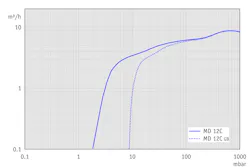
To maintain the vacuum depth required for effective and efficient evaporation, a pump should be sized to quickly and efficiently remove generated vapors from the system. Referencing a pump’s dedicated pumping curve helps determine the anticipated flow rate and performance of the equipment when the system is under load and helps ensure the pump selected has enough working capacity to maintain the required vacuum depths.
Account for Changing Process Conditions at Scale
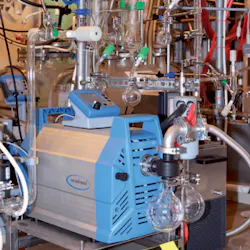
As systems scale multiple variables directly affecting vacuum performance change. Total system evacuation times increase, leaks become larger and more apparent, vapor loads increase, and thermal transfer to solvents and mixtures can become less uniform. Remembering to identify and mitigate these early in scale-up development helps ensure anticipated vacuum performance is achieved.
Use Bench-Scale Data to Inform Pump Selection
Thorough documentation of successful bench-scale conditions provide a valuable foundation for selecting vacuum equipment at larger scales.
In depth documentation of bench conditions make replication at scale much easier and there are a few key parameters regarding vacuum to remember. Knowing the amount of vapor generated, and any that was subsequently removed through condensers before reaching the vacuum pump, is crucial for proper pump sizing. Though knowing the rated size of the pump used during bench testing is helpful it does not give the full picture of that pump’s performance under load. Remembering to reference pump curves to determine the pumps true performance when under load can help further determine proper sizing at scale. Other parameters such as total system volume, changing solvent/mixture composition, vacuum control requirements, and operating temperature will directly affect vacuum performance at scale and should be considered.
Match Vacuum Control to Process Requirements
Vacuum control can be critical to process success and there are multiple pump types and control techniques to help accomplish this depending on a process’ goals and needs. Remembering to identify the overarching goal of the process early can help determine which control mode is best. Some operations only need a stable vacuum source with no, or relatively simple, controls where others may require full automation, defined vacuum setpoints, or multi-step protocols.
For example, adaptive variable-speed vacuum control adjusts pumping speed in response to real-time process demands or in accordance to a predefined protocol. This gives a smooth vacuum profile with extreme accuracy. If an evaporation process requires extreme precision with minimal solvent carry over between steps, then this is a good control type. Pumps such as the VACUUBRAND VARIO® select series can further help by automatically detecting evaporation conditions and adjusting accordingly. This maximizes the evaporations efficiency and minimizes carry over by and keeping the evaporation from over-boiling uncontrollably.
Standardize Data Collection and Logic Across Scales
When designing a process at scale, remembering ancillary equipment’s available data and interfacing capabilities can also be beneficial for the long term. Equipment capabilities such as data logging and protocol transfer can help simplify personnel training, SOP development, and may also be required for regulatory and GMP compliance. It can also be used when working on post-design process optimization and continuous improvement. Furthermore, the ability to have a common logging and control interface across different scales (IE, the same control interface and pump function at the bench top and at scale) can be extremely helpful, especially in industries where formulations and vacuum requirements change frequently such as in contract design and manufacturing.
Supporting Vacuum Performance from Bench to Kilo Lab
Vacuum pumps are not a one-size-fits-all tool and pump selection is critical to a successful scale-up project. Keeping in mind the process parameters affecting vacuum performance helps ensure scaling from the bench to kilo-lab or manufacturing goes smoothly.
VACUUBRAND® offers the widest range of chemistry diaphragm pumps and vacuum control options on the market allowing for true pump sizing and a seamless transition between benchtop, scale-up, and kilo-lab. As a global leader in the vacuum industry with over 70 years of vacuum expertise, VACUUBRAND and BRANDTECH® Scientific are a resource to support your system sizing and selection.
Contact BRANDTECH Scientific to discuss the vacuum requirements of your process, or read more at BRANDTECH.com
Sponsored By: