Cellares, Ori Biotech square off in battle to automate the manufacturing of cell therapies
While cell therapies are among the most promising medicines, they are complex to manufacture with scale-up an obstacle to regulatory approval and commercialization. What the sector needs is to advance innovative manufacturing solutions required to improve scalability and commercial viability, according to a new report from data intelligence platform Tracxn.
The firm makes the case that although the cell therapy sector continues to achieve major regulatory milestones and develop robust clinical pipelines, the manufacturing infrastructure has not kept pace with innovation. Automated, closed, and digitized processes are necessary to reduce product variability, decrease cost of goods sold, and scale up for high-throughput production.
“The manual, cleanroom-intensive model for cell therapy manufacturing has a structural ceiling,” the report states. “With high per patient cost and 1-18% batch failure rates, it cannot scale to meet the potential demand implied by 6,000+ interventional cell therapy trials registered globally.”
Two companies that are leading the race to build cell therapy’s first automated factories are Cellares and Ori Biotech, which together account for approximately 81% of the $1.1 billion in capital raised across 34 rounds from 2016 through April 2026, according to Tracxn.
During that period, the report found Cellares secured $612 million and Ori Biotech pulled in $281 million, while the remaining 11 funded companies within the ecosystem shared $205 million between them. This week, Cellares added a $50 million investment from a private equity firm to the company’s Series D financing, bringing the total raised to $327 million.
“Commercial-stage solutions are emerging, led by Cellares and Ori Biotech,” Tracxn said.
Cellares vs. Ori Biotech
As the industry looks to produce cell therapies at scale, Cellares and Ori Biotech are each providing manufacturing technology solutions that leverage automation. In 2025, both companies announced that they received the Advanced Manufacturing Technology (AMT) designation from the U.S. Food and Drug Administration (FDA), “making them among the first technologies anywhere in pharma to receive the designation,” according to Tracxn.
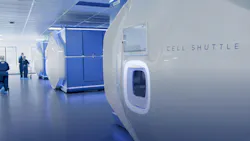
Cellares claims its Cell Shuttle performs automated, end-to-end, cell therapy manufacturing, including the processes of cell enrichment, cell selection, transduction, transfection, activation, expansion and formulation while meeting all in-process and final product specifications of commercial cell therapies. The technology reduces labor requirements by up to 80% and facility footprint by up to 90%, according to the company.
Ori Biotech’s IRO platform has also received the FDA’s AMT designation, which the company contends validates the system as one of the first next-generation technologies recognized under the program. The IRO system automates, digitizes, and standardizes labor-intensive steps of cell therapy manufacturing in a fully closed system. According to Ori Biotech, the platform reduces costs, increases throughput, lowers batch failure rates, and enables scalability from research through GMP manufacturing.
Industry milestones over next 12-36 months
Several events in a year to three-year timeframe could materially shift competitive positions in the cell therapy manufacturing space, according to Tracxn. The firm considers which companies/platforms might receive AMT designations from the FDA over the next 12-18 months.
“A third or fourth designation [beyond those previously secured by Cellares and Ori Biotech] would indicate a systemic regulatory shift, not just two isolated events,” the report said. “Cellular Origins, Multiply Labs, and Aglaris are among the platforms with the commercial maturity and GMP deployment status that would make them plausible candidates.”
The first fully autonomous commercial GMP batch is a significant milestone to watch for over the next 18-30 months, according to Tracxn, specifically a GMP batch released for patient use with zero manual operator intervention, no human hands at any step, full electronic batch record, and real-time release testing.
“No company has publicly announced this milestone,” the report noted. “Whoever achieves it first defines the benchmark.”
Over the next 24-36 months, Tracxn said a major milestone that could be achieved is the first commercial allogeneic factory deployment, specifically an allogeneic therapy reaching commercial approval and deploying an automated factory to produce multiple doses per year.
“This would be the first commercial-scale test of the industrial manufacturing model for cell therapy,” the report said. “Watch for allogeneic CAR-T and CAR-NK approvals potentially mid-decade, subject to positive pivotal data, Allogene’s cema-cel is the furthest advanced program, with key efficacy data anticipated 2027-2028.”
About the Author
Greg Slabodkin
Editor in Chief
As Editor in Chief, Greg oversees all aspects of planning, managing, and producing the content for Pharma Manufacturing’s website and digital products, as well as the daily operations of its editorial team.
For more than 20 years, Greg has covered the healthcare, life sciences, and medical device industries for several trade publications. He is the recipient of a Post-Newsweek Business Information Editorial Excellence Award for his news reporting and a Gold Award for Best Case Study from the American Society of Healthcare Publication Editors. In addition, Greg is a Healthcare Fellow from the Society for Advancing Business Editing and Writing.
When not covering the pharma manufacturing industry, he is an avid Buffalo Bills football and Buffalo Sabres hockey fan, likes to kayak, and plays guitar.