Cleanroom HMI for pharma and life science production areas
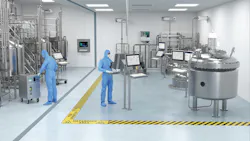
Human-machine interfaces (HMIs) play a critical role in pharmaceutical and life science automation by enabling operators to monitor and control equipment and processes safely and efficiently. HMIs serve as a communication bridge between humans and machines, providing the software interface and associated hardware allowing operators to understand what is occurring in a critical process.
Pepperl+Fuchs offers a comprehensive range of Good Manufacturing Practices (GMP)-compliant products specifically designed for complex production processes and quality assurance, including demanding cleanroom environments. From real-time monitoring and documentation to secure signal transfer and explosion protection, the company’s solutions are designed to ensure operations meet the highest standards of safety and regulatory compliance.
In this interview with Pharma Manufacturing, Rob Iten, market manager for pharma and life sciences at Pepperl+Fuchs, discusses how the industry is adopting cleanroom HMI in controlled, hygienic environments to allow for the safe operation and monitoring of processes, while maintaining strict cleanliness standards.
Q: When you talk about cleanrooms, what exactly do you mean by this?
A: In short, it’s exactly as it sounds: a clean room. However, it’s a bit more involved than that. Pharmaceutical cleanrooms are a highly controlled and regulated environment engineered to maintain low levels of dust, debris, particulates, and chemical vapors. This is accomplished through various means, including different levels of filtration, positive pressure, unidirectional airflow, strict gowning and room entry protocols. Cleanrooms are classified into grades A, B, C, and D based on the maximum number of particles per cubic foot of air and are defined by ISO and EU GMP classifications.
Q: What are the general requirements for industrial PCs or HMI going into these sorts of cleanrooms?
A: This greatly varies from site to site, country to country, and process to process. However, there are some consistencies across all cleanrooms. The first is typically the level of GMP that the hardware conforms to. GMP conformance with regards to HMI hardware has a lot to do with the level of cleanability.
Is the HMI easy to clean and without any cracks or crevices, where cleaning is a challenge or where bacteria or contaminants could get trapped? Is the hardware resistant not only to the chemicals it may be exposed to during the normal process, but also to the solvents and cleaning agents used to sterilize the equipment? Is there an ingress protection rating on the hardware to prevent any water and/or dust ingress and allow for different types of washdowns?
Materials such as 316L stainless steel, glass touchscreens, and chemical-resistant membrane keyboards are very commonplace in these applications, as they can meet and exceed the GMP and IP or Type Rating requirements for the various production sites.
On top of all the GMP requirements, a smaller subset of cleanroom applications also may have potentially explosive chemicals, gases, or dust which are part of the process — so explosion protection requirements also come into play. In these cases, we’re talking about HMI certified for Class I/II, Division 1 or Division 2 in North America (or Zone 1/21 and Zone 2/22 for the global sites). How the process area is defined with respect to hazardous locations — which often involve specialized experts and third-party safety and certification companies — is just another key point to think about when defining the hardware requirements for use.
Q: What hardware features are critical for usage within these process areas?
A: Physical space within these cleanrooms can often be a major problem, so flexibility and varying options — with regard to how the HMI actually mounts — are a huge topic. Having multiple mounting options for different areas is critical. This could mean that in some areas you may have a fixed, floor-mounted pedestal HMI, but in other areas you may have an HMI on an articulating arm or built into or flush-mounted against the wall. Another option that is becoming increasingly more common is a truly mobile cart or trolley type solution — something on wheels, using WiFi/Bluetooth and potentially battery power to be able to move it from area to area within the process.
Going hand in hand with mounting flexibility is the topic of ergonomics. Often, at production sites, there are ergonomic guidelines that should be adhered to as closely as possible to support operators of different heights and in different work environments. Having an HMI and any peripheral devices that are able to be properly moved or positioned to best suit the operator and put them in a comfortable position helps immensely here.
Q: Speaking of peripheral devices, what sorts of accompanying products are utilized with a cleanroom HMI?
A: In cleanroom production areas, traceability and recordkeeping are critical. As a result, it’s very common for barcode scanners to be used throughout the process to scan ingredients, recipes, and whatever else may be required to be tracked
Another thing becoming much more prevalent is some type of RFID or badge reader for validating and logging into the HMI or a particular software application. Operators may have a credential badge or a biometric wristband they can use to securely and easily log in by simply holding it up to the RFID reader, which means no more manual entry of user credentials and passwords. Even more future-facing could be things like retinal scanners tied to each of the individual operators.
Keyboards and pointing devices are another very common accessory added to these HMIs. Just like every other type of “HMI” we use in our daily life — such as tablets and phones — touchscreens are pretty much standard and utilized across cleanroom environments. However, depending on the level of data entry being done in a particular process, having a physical keyboard and pointing device like a touchpad, joystick, or trackball can be a huge boon to the operator and give them a more comfortable and efficient experience.
Q: When it comes to interfacing with the control system and other software, how is this accomplished?
A: In most pharmaceutical applications, it’s becoming increasingly more routine for various types of thin client architectures to be utilized. This typically involves a client HMI using a network-based protocol, such as Microsoft Remote Desktop Protocol (RDP), Emerson DRDC, or VNC to connect back to the main host server located in a secure, IT-controlled location elsewhere on site. On that host server, all of the computing power, application-specific software, interface to the DCS/PLC, and whatever else is centralized and much easier to manage.
Using a thin-client-based installation offers many benefits from operational, security, software compliance, and overall hardware longevity standpoints. From a Pepperl+Fuchs standpoint, we support all options. Not only do we offer all of our HMI solutions as either a traditional PC with Windows, but we offer them as a thin client with a choice of either our RM Shell 6 firmware offering, a Rockwell ThinManager Ready option, or an IGEL OS Linux-based operating system.