Autolomous, Cellular Origins link platforms for cell therapy scale-up
Autolomous, a digital manufacturing software provider, and Cellular Origins, a Cambridge, UK-based biotechnology company, have announced end-to-end integration of their respective production platforms, creating a connected, automated, and digitized cell therapy manufacturing environment.
The integrated solution combines Cellular Origins’ Constellation automated platform — which incorporates mobile robotics, bioprocessing technologies and sterile fluid transfer into a coordinated operation — with Autolomous’ autoloMATE digital platform, which enables real-time data exchange across software, artificial intelligence systems, devices, and robotic platforms throughout the manufacturing process and supply chain. The autoloMATE platform also includes intellectual property safeguarding capabilities, the companies said.
The combined solution is reportedly designed to address fragmentation, limited process visibility, and the absence of standardized and interoperable data flows without replacing existing systems. The modular architecture of both platforms allows manufacturers to scale capacity as demand grows, while maintaining standardized processes, reducing scale-up risk, and avoiding therapy redevelopment, according to the announcement.
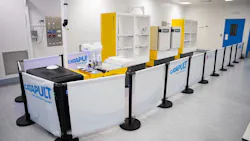
Initial integrations have already been completed at the Cell and Gene Therapy Catapult Digital and Automation Testbeds in Stevenage, UK, the companies said, demonstrating how robotic platforms and digital infrastructure can operate as a unified system.
“Scientific ambition has never been the bottleneck in bringing innovative cell therapy to patients, but the delivery infrastructure has brought many challenges,” Alexander Seyf, CEO of Autolomous, said in a statement. “Together with Cellular Origins, we enable fast and efficient scaling from research through to patient administration, ensuring standardization, automation and digitization across the entire process.”
Edwin Stone, CEO of Cellular Origins, added that scaling cell therapy manufacturing requires more than automation — it requires a manufacturing system that can evolve with demand, and that the joint work with the Cell and Gene Therapy Catapult demonstrates how robotic and digital infrastructure can operate as one.
The development builds on Cellular Origins’ recent collaboration activity. In May 2026, the company announced a partnership with Immatics, a Germany-based late-stage clinical biopharmaceutical company, to evaluate the Constellation robotic platform within Immatics’ immuno-oncology cell therapy manufacturing processes, with initial milestones targeted for this year. That effort follows a January 2026 collaboration with Fresenius Kabi to integrate robotic systems into existing cell processing workflows with the goal of reducing variability and improving operational efficiency.