AstraZeneca designs cell therapy facility for zero downtime
Cell therapy manufacturing is entering a new phase of commercial maturity after several years of uneven growth. Momentum accelerated in 2025, with the cell and gene therapy sector recording approximately $12 billion in disclosed investment activity, according to the International Society of Cell and Gene Therapy.
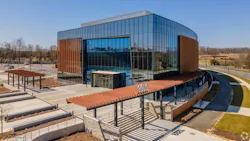
One company investing heavily in that future is AstraZeneca. In 2025, the company opened its $300 million commercial cell therapy facility in Rockville, Maryland, reinforcing its long-term commitment to manufacturing. Now in 2026, the Rockville facility has been recognized as one of the winners of 2026 Facility of the Year Awards by the International Society for Pharmaceutical Engineering (ISPE).
“As an industry, I like to say we're kind of like moving up the S-curve,” says Heather Francis, head of cell therapy manufacturing at AstraZeneca. “We’ve been for a while at the bottom of that curve, but now with investment by AstraZeneca and our peers, we’re starting to move up the S-curve in a way that we can really adopt the technologies and scale out what’s needed for these advanced therapies to be realized and have many patients have access. I’m really proud of not only this award, but also all the work we do at AstraZeneca in this space. It’s really exciting.”
The ISPE Award
Last April, the ISPE announced its 2026 Facility of the Year Award category winners, recognizing pharmaceutical and biopharmaceutical manufacturing projects that demonstrate excellence in innovation, operations, supply chain, Pharma 4.0, as well as social impact.
The winning facilities in each category spanned a range of “state-of-the-art projects utilizing new, innovative technologies to improve the quality of products, reduce the cost of producing high-quality medicines, and demonstrate advances in project delivery,” according to the ISPE. AstraZeneca’s commercial cell therapy facility was awarded in the category of “Social Impact — Unmet Medical Needs.”
AstraZeneca’s 105,000-square-foot, three-story biomanufacturing facility is designed to support commercial-scale autologous T-cell therapy production and late-stage oncology clinical trials — and ultimately deliver therapies for up to 4,000 patients annually, the company said. The facility’s all-electric design underpins engineering decisions that helped it earn the award. By eliminating natural gas infrastructure and designing around continuous operations, AstraZeneca says the facility can maintain 100% uptime while reducing both energy and water consumption by roughly 50%.
Rather than treating reliability, sustainability, and commercial scalability as separate engineering objectives, the project was designed to achieve all three simultaneously, says Francis.
Continuous operation is particularly important in autologous cell therapy, where each manufacturing batch represents an individual patient and treatment timelines can be measured in days.
“The patient impact of this project is both profound and measurable,” according to the official award announcement. “For patients with weeks or months to live, even a brief interruption in manufacturing can mean a lost chance at survival. By eliminating single points of failure across electrical, mechanical, automation, and process utilities, the facility protects every in-process batch as a proxy for the patient themselves.”
The importance of 100% uptime
Compared to traditional biologics manufacturing — where things like planned facility shutdowns for maintenance are an accepted part of the process — the time-sensitive nature of delivering cell therapies to critically ill patients require maintaining non-stop operations.
“The model of traditional biologics manufacturing just doesn’t work in cell therapy because we make every batch for every patient, and there’s no inventory,” according to Francis. “We can’t stockpile a patient’s cells because they’re autologous; they’re meant for an individual patient.”
Highlighted in the ISPE award announcement, the facility project team borrowed resiliency methodologies from industries such as nuclear power, oil refining and Tier IV data centers. The team used quantitative risk assessments and layers of protection analysis to effectively eliminate the risk of total power loss.
“We looked to industries where uninterrupted performance is an imperative. Being 100% operational is mission critical for data centers, nuclear power sites, oil refineries, because, and they have decades of experience designing systems where a failure is unacceptable,” says Francis. “Data centers have very little downtime, and we adopted the philosophy to minimize downtime in our electrical architecture by having dual independent power feeds.”
Francis also pointed to the facility’s on-site power generation, uninterrupted power supplies, centralized monitoring systems, and redundant data rooms as key components of its resiliency strategy.
A smarter cell therapy facility
Designing a facility around uninterrupted operations also means a stronger push toward digitalization efforts. With systems being monitored continuously, technologies such as automation, predictive analytics, and artificial intelligence (AI) become natural extensions of the facility’s operating model.
“We have incorporated smart factory capabilities and some AI-enabled workflows for real-time visibility of our asset health,” says Francis. “But we have to take that to the next level with process robotics and QC automation to enable right-first-time manufacturing and more parallel processing with a smaller footprint.”
She emphasized the significance of automation toward the industrialization of cell therapy manufacturing and improving patient access to cell therapies, while noting the company’s recent partnership with Multiply Labs to enable automated end-to-end cell therapy manufacturing with robotics.
“We would expect to have significant uptime on robotics to get the throughput that’s necessary to serve patients in need of these therapies,” commented Francis.
More broadly, AI is becoming increasingly embedded in pharmaceutical manufacturing processes across the industry.
“We’ve talked about concepts like real-time quality monitoring and predictive maintenance for a long time, and I think we’re at this inflection point where AI can really deliver on some of the promises that we’ve talked about in the industry for a number of years,” according to Francis.

Building with Sustainability
Another reason the Rockville facility stood out to ISPE is that it challenges the assumption that improving resiliency is at odds with maintaining sustainability.
Francis made the case that sustainability was never treated as an afterthought but was established alongside reliability and patient access as a core design principle from the earliest planning stages.
“It was really built into our design principles. We brought development, manufacturing, supply chain, thinking about sustainability together from the outset to design a facility to enable that end-to-end system from the moment the patient cells arrive through to processing and like the outbound logistics. And we made a deliberate choice to continue to build entirely around single-use technology.”
The facility is built entirely around single-use technologies, a common approach in autologous cell therapy that eliminates the need for conventional clean-in-place systems. Besides supporting individualized manufacturing, the design also significantly reduces steam, water, and utility demands.
“That fundamentally changes our utility footprint and of course, water consumption,” Francis says. “That was a real critical enabler of our electrification strategy.”
She emphasized that there was no natural gas infrastructure anywhere on site and estimated an elimination of six million pounds of carbon dioxide annually.
Looking ahead
Reflecting on the ISPE award, Francis said the recognition validates not only AstraZeneca’s approach but also a manufacturing model that could shape future cell therapy facilities.
“This recognition really affirms that with this purpose-driven design, with rigorous engineering, we can deliver real outcomes for real people,” according to Francis. “And the principles are transferable. We have early integration of sustainability as a core principle in our case. And we can design out like single points of failure and align our infrastructure to this really unique modality of cell therapy. And I think this can inform future projects, not only for AstraZeneca, but also across our industry as we advance the field.”
About the Author
Andy Lundin
Senior Editor
Andy Lundin has more than 10 years of experience in business-to-business publishing producing digital content for audiences in the medical and automotive industries, among others. He currently works as Senior Editor for Pharma Manufacturing and is responsible for feature writing and production of the podcast.
His prior publications include MEDQOR, a real-time healthcare business intelligence platform, and Bobit Business Media. Andy graduated from California State University-Fullerton in 2014 with a B.A. in journalism. He lives in Long Beach, California.