Eli Lilly feels strain of its $50B US capital expansion since 2020
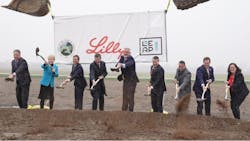
Since 2020, Eli Lilly has committed more than $55 billion globally to capital expansion, with over $50 billion in the U.S. However, Lilly is feeling the strain of this Herculean effort, according to Steve Marr, head of the company’s global facilities delivery parenteral.
“Lilly was like any other medium size pharma company doing $500 million to $700 million in capital investment for 20 years,” Marr told the Advancing Life Science Construction conference on Tuesday in Raleigh, North Carolina. Over the past five years, he said Lilly’s U.S. capital investment has “prompt jumped” to $50 billion.
Last year alone, the drugmaker pledged $27 billion to build four new domestic pharmaceutical manufacturing sites — three for active pharmaceutical ingredients (APIs) and one to manufacture parenteral (injectable) products and devices.
“Lilly is going through what I call transformational capital growth,” Marr said. “We can’t build our facilities fast enough.”
Marr, who is the program director responsible for building Lilly’s API manufacturing facility in Lebanon, Indiana, said the pharma giant is spending billions of dollars to meet the increasing global demand for its blockbuster diabetes and obesity medications Mounjaro and Zepbound, as well as next-generation GLP-1s in pill form.
Lebanon is “not a capital project” but a “capital program” at one site, according to Marr, who noted that it has more than 300 miles of piping. “Think of that as six mega-projects at one site.”
The problem is Lilly “can’t get the resources” it needs, Marr said, starting with “craft” — referring to the specialized skills and knowledge required to design, build, and maintain facilities that meet the standards and requirements of the pharmaceutical industry. “Six thousand craft we’re trying to get,” he added. “The demand is unprecedented in resources.”
Resourcing is a major barrier for Lilly, which is “struggling” to find the talent at a high level required for these capital expenditure projects, according to Marr.
“I need six top project directors — how many people out there know six project directors that have delivered on $2 billion projects?” he exclaimed.
The industry’s building boom is also a challenge as companies are competing to secure construction workers, including electricians. A Q4 2025 Market Conditions report from DPR Construction flagged the labor shortages impacting a myriad of industries.
“Everyone’s building like this,” Marr said. “I could go on and on about the challenges that we have … It’s unprecedented. It’s transformational. And we haven’t figured it out yet.”
Building capacity for GLP-1s
Lilly’s total investment in the Lebanon manufacturing site increased in 2024 from $3.7 billion to $9 billion to boost capacity to manufacture APIs for Mounjaro and Zepbound, whose active ingredient is tirzepatide — a synthetic peptide. According to Lilly, it is the single largest investment in API manufacturing of synthetic medicines in U.S. history.
As part of its $27 billion U.S. investment announced in 2025, Lilly is building three new manufacturing facilities for APIs. Last year, Chief Financial Officer Lucas Montarce said that Lilly’s Lebanon construction is a good “proxy” for those three API sites.
In December 2025, Lilly announced plans to invest $6 billion in a new API manufacturing facility in Huntsville, Alabama that will produce small molecule synthetic and peptide medicines. A $6.5 billion API facility in Houston, Texas, announced in September, will focus on domestic production of small molecule synthetic medicines. Lilly also plans to build a $5 billion API manufacturing facility in Virginia, near Richmond.
While Lilly has planned major investments in manufacturing, it will take years before the company sees increases in capacity, according to Montarce.
“When we think about new lines or new sites coming online, it’s not a big acceleration of new doses that will become available,” Montarce told the Leerink Partners Global Healthcare Conference last year. “We expect that continuation to grow over time,” he cautioned. “It’s not that we accumulate basically a significant expansion with a new site coming online.”
About the Author
Greg Slabodkin
Editor in Chief
As Editor in Chief, Greg oversees all aspects of planning, managing, and producing the content for Pharma Manufacturing’s website and digital products, as well as the daily operations of its editorial team.
For more than 20 years, Greg has covered the healthcare, life sciences, and medical device industries for several trade publications. He is the recipient of a Post-Newsweek Business Information Editorial Excellence Award for his news reporting and a Gold Award for Best Case Study from the American Society of Healthcare Publication Editors. In addition, Greg is a Healthcare Fellow from the Society for Advancing Business Editing and Writing.
When not covering the pharma manufacturing industry, he is an avid Buffalo Bills football and Buffalo Sabres hockey fan, likes to kayak, and plays guitar.