Eli Lilly plans to invest $6B in new API manufacturing facility in Alabama
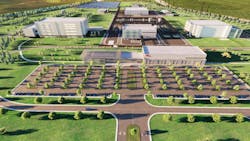
The third of four new U.S. manufacturing sites Eli Lilly plans to announce this year will be built in Huntsville, Alabama. Described as a next-generation synthetic medicine active pharmaceutical ingredient (API) facility, the site will be among those that manufacture Lilly's oral GLP-1 receptor agonist orforglipron, according to Tuesday’s announcement.
The new site, Lilly’s ninth U.S. manufacturing facility announced since 2020, will leverage technologies including AI and machine learning, digitally integrated monitoring systems, as well as data analytics. The drugmaker said digital automation will be embedded throughout the Huntsville site to “streamline operations and ensure a reliable supply of safe, high-quality medicines.”
Expected to be completed in 2032, the Huntsville site will focus on domestic production of small molecule synthetic medicines, including the manufacture of Lilly’s oral GLP-1 orforglipron — which the company plans to submit to global regulatory agencies for obesity by the end of this month.
According to Lilly, the Huntsville site was selected from more than 300 applications with its decision partially based on its proximity to the HudsonAlpha Institute for Biotechnology, a nonprofit bioscience campus that supports workforce training and research.
“Huntsville’s track record of science and innovation, supported by advanced manufacturing expertise and a skilled workforce, makes Alabama an ideal location for Lilly to expand domestic manufacturing capacity for next‑generation medicines,” CEO Dave Ricks said in a statement, while noting the company’s continued investment in onshoring API production.
Investment in APIs
In February, Lilly announced a $27 billion investment to build four new U.S. pharmaceutical manufacturing sites — three for APIs and one to manufacture injectable products and devices. The three API facilities will be built in Alabama, Texas, and Virginia, while an announcement for the fourth U.S. location will be made in the coming weeks.
A $6.5 billion API facility in Houston, Texas will focus on domestic production of small molecule synthetic medicines, including orforglipron. A $5 billion API manufacturing facility near Richmond, Virginia is meant to boost Lilly’s domestic production for cancer, autoimmune, and other advanced therapies.
Since 2020, Lilly has committed more than $55 billion globally to grow its manufacturing capacity, with more than $50 billion in the U.S. Driven by the Trump administration’s threat of imposing industry-specific tariffs, 2025 has been a year of monumental pledges by Big Pharma with large pharmaceutical companies committing to invest more than $370 billion over the next five years to onshore manufacturing.
Tariffs are increasing costs on APIs, raw materials, and lab supplies which is causing drugmakers such as Lilly to take “calculated steps to reduce exposure,” according to consulting firm West Monroe’s 2026 Life Sciences Industry Outlook. As an example, the report pointed to Lilly’s $5 billion investment in a new U.S. manufacturing site in Virginia to shore up access to APIs and mitigate future supply risk.
“Rather than fully reshoring, many firms are hedging against policy shifts and tariff volatility — adding domestic capacity while keeping trusted overseas partners,” West Monroe said. “Clinical development will stay global, with trial activity shifting toward lower-tariff regions as logistics and compliance footprints remain globally distributed.”
Last month, Lilly announced it will build a $3 billion oral medicine manufacturing facility in the Netherlands. The capital expenditure is meant to boost Lilly’s capacity in Europe for patients worldwide and strengthen its global supply chain.
Lilly also said recently it is investing $1 billion in India to expand contract manufacturing capacity. The move will reportedly strengthen the company’s supply chain through local partnerships and support its global production network.
About the Author
Greg Slabodkin
Editor in Chief
As Editor in Chief, Greg oversees all aspects of planning, managing, and producing the content for Pharma Manufacturing’s website and digital products, as well as the daily operations of its editorial team.
For more than 20 years, Greg has covered the healthcare, life sciences, and medical device industries for several trade publications. He is the recipient of a Post-Newsweek Business Information Editorial Excellence Award for his news reporting and a Gold Award for Best Case Study from the American Society of Healthcare Publication Editors. In addition, Greg is a Healthcare Fellow from the Society for Advancing Business Editing and Writing.
When not covering the pharma manufacturing industry, he is an avid Buffalo Bills football and Buffalo Sabres hockey fan, likes to kayak, and plays guitar.