Lotte Biologics completes construction of South Korean manufacturing plant
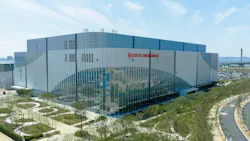
Two years after breaking ground, South Korean headquartered contract development and manufacturing organization (CDMO) Lotte Biologics has completed construction and received approval for use of Plant 1 at its Songdo Bio Campus in Incheon, South Korea.
The company contends the milestone achieved approximately two years after the start of construction in 2024 represents an “exceptionally fast project execution timeline among global biologics manufacturing facility construction projects.”
The 120,000-liter Songdo Plant 1 is designed for antibody therapeutic manufacturing to support large-scale commercial production demand with eight 15,000-liter stainless steel bioreactors. The facility, which leverages advanced bioprocessing technologies including higher-titer cell culture and perfusion processes, is scheduled for full-scale commissioning and production system validation in the second half of 2026.
At the start of the design stage, Lotte said it implemented an automated Manufacturing Control System (MCS) to boost production efficiency and quality at Plant 1, which also includes an automated warehouse and real-time monitoring-based operating systems to improve manufacturing stability and efficiency.
The company, which was created in 2022, is investing $1 billion in its Songdo Bio Campus in South Korea with the goal of becoming a global top 10 CDMO. Lotte’s plan is to ultimately build three plants at the Incheon site by 2030 and achieve full operation by 2034.
CEO James Park, who took the helm of Lotte Biologics in December 2024, told Pharma Manufacturing last year that “there’s definitely going to be a need for more mAbs in the near future, which is one of the reasons why we’re building large capacity in Korea.”
At the same time, Park sees the CDMO as well-positioned to manage the geopolitical tensions and uncertainty in the industry with its U.S. footprint. “We’re in a good place in terms of having a facility in Syracuse, New York,” he said.
Dual-site strategy takes shape
Last year, Lotte started full-scale operations at its 45,000-square-foot manufacturing facility in Syracuse, New York. The company has positioned itself as a U.S.-based single source antibody-drug conjugate (ADC) partner, from cell culture to conjugation.
Services at the Syracuse Bio Campus are marketed as an option for customers looking to derisk and regionalize production amid geopolitical uncertainty. The campus, a former Bristol Myers Squibb site, is one of the few ADC conjugation sites on the East Coast and one of the largest conjugation capabilities for ADC production in the U.S., according to Lotte.
“As a company, we’re investing in the large-scale investment in Songdo to demonstrate our dual-site strategy,” Ryan Stelick, senior director of manufacturing operations at Lotte’s Syracuse Bio campus, told Pharma Manufacturing earlier this year. “We’re going to leverage teams at both sites to deliver at scales from early clinical through commercial production.”
Brian Greven, general manager of the Syracuse Bio Campus, called it an operating model of “two sites and one CDMO” with globally aligned policies and procedures. “We’re leveraging the expertise from a quality standpoint, specifically as it relates to our regulatory history and our commercial track record to enable that site in South Korea to start up successfully,” he added.
Under Lotte’s dual-site strategy, the Syracuse Bio Campus is designed to support early-stage customer projects and clinical supply while Songdo Plant 1 will serve as a large-scale commercial manufacturing base. Combined, the company’s global capacity will reach 160,000 liters, including 40,000 liters at its Syracuse Bio Campus with eight 5,000-liter stainless steel bioreactors.
“Based on our global manufacturing platform connecting Syracuse and Songdo, we will establish ourselves as a trusted CDMO partner for customers worldwide,” Park said in a statement. “With an integrated manufacturing system that combines speed, quality, and production flexibility, we will proactively respond to the diverse development and commercialization needs of global customers and continue growing into a world-class CDMO company.”
Related Listening
In the following episode of Off Script: A Pharma Manufacturing Podcast, we spoke with Mel Radford, director, life sciences global accounts at Rockwell Automation, about the key barriers to autonomous bioprocessing and how companies can move from reactive operations toward predictive and closed-loop process control. Hear the full episode below.
About the Author
Greg Slabodkin
Editor in Chief
As Editor in Chief, Greg oversees all aspects of planning, managing, and producing the content for Pharma Manufacturing’s website and digital products, as well as the daily operations of its editorial team.
For more than 20 years, Greg has covered the healthcare, life sciences, and medical device industries for several trade publications. He is the recipient of a Post-Newsweek Business Information Editorial Excellence Award for his news reporting and a Gold Award for Best Case Study from the American Society of Healthcare Publication Editors. In addition, Greg is a Healthcare Fellow from the Society for Advancing Business Editing and Writing.
When not covering the pharma manufacturing industry, he is an avid Buffalo Bills football and Buffalo Sabres hockey fan, likes to kayak, and plays guitar.