Fujifilm doubles quality control footprint at Danish commercial-scale manufacturing site
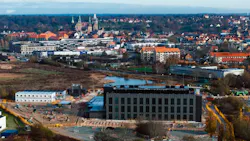
Fujifilm Biotechnologies has opened a new 2,000‑square‑meter quality control (QC) laboratory at its large-scale commercial manufacturing site in Hillerød, Denmark, leveraging robotics and a company-wide lab information management system (LIMS) implementation to enable expanded bioassay and virology operations.
Staffed by a 100-member quality team, the QC lab at the Hillerød site will perform viral safety testing for drug substance and product releases, scale capacity for complex cell‑based potency and enzyme-linked immunosorbent assay (ELISA) methods, as well as conduct raw material and total organic carbon cleanability studies.
“We are a one-stop shop for our clients, so they don’t have to do their analysis of the materials somewhere else — we can do that for them,” Christian Houborg, Fujifilm Biotechnologies’ senior vice president and Hillerød site head, told Pharma Manufacturing. “Some of the analysis we’re able in the future to react within 14 days instead of 28 days, and it’s also bringing in the capabilities for increasing productivity significantly.”
Houborg described it as an “evolution” of Fujifilm Biotechnologies’ QC capabilities and said the new lab shares some of the same technologies as the existing footprint, with “some advanced robotics” and “some new analytical methods that we are implementing while bringing the new facility online.”
The QC lab is part of Fujifilm Biotechnologies’ ongoing LIMS implementation across the company’s global network of sites to enable digital harmonization and data integrity, according to Houborg.
“LIMS is helping us become more productive and also helping us to integrate our data across our systems,” he said, making “the data flow seamlessly.”
Housed within a new 7,600-square‑meter building, the QC lab received approval from the Danish Medicines Agency based on an on‑site inspection and will begin operations next month to meet customer demand and support expansion at Hillerød.
“This QC capacity will cover the site for a while,” Houborg said, noting that the new lab features ventilation systems, personnel and material airlocks, as well as an open‑plan layout. “The whole facility is built in a way where we can add additional buildings to that spine.”
Plans to add more bioreactors
In late 2024, Fujifilm Biotechnologies doubled the Hillerød site’s capacity from six to twelve 20,000-liter mammalian cell culture bioreactors, which required expanded QC capabilities and advanced analytical equipment to support current and future demand, according to Houborg.
“We have eight more [bioreactors] that will come later,” said Houborg, noting that the Hillerød site plans to offer a total of twenty 20,000-liter bioreactors for drug substance production complemented by drug product and finished goods services, making it the largest end-to-end cell culture contract development and manufacturing organization (CDMO) in Europe.
The site’s new QC lab capacity is a critical component of Fujifilm Biotechnologies’ investment in the additional eight 20,000-liter bioreactors, according to Houborg. “This is really to enable that future growth of the site.”
Houborg also said the new QC lab at Hillerød is part of Fujifilm’s modular approach to biomanufacturing called KojoX, which has harmonized the design of its facilities, equipment, processes, and digital systems to enable cross‑site workflows and the consistent application of quality standards across its global CDMO network.
“KojoX is about using the same equipment, bioreactors, same design of the facilities,” Houborg added. “It’s also about creating an information platform that is fit for purpose.”
By linking manufacturing facilities across regions, Fujifilm Biotechnologies is looking to provide its customers with flexible worldwide capacity and local supply, combining large-scale, stainless-steel bioreactors in Denmark and North Carolina with smaller single-use systems in Japan and the UK.
About the Author
Greg Slabodkin
Editor in Chief
As Editor in Chief, Greg oversees all aspects of planning, managing, and producing the content for Pharma Manufacturing’s website and digital products, as well as the daily operations of its editorial team.
For more than 20 years, Greg has covered the healthcare, life sciences, and medical device industries for several trade publications. He is the recipient of a Post-Newsweek Business Information Editorial Excellence Award for his news reporting and a Gold Award for Best Case Study from the American Society of Healthcare Publication Editors. In addition, Greg is a Healthcare Fellow from the Society for Advancing Business Editing and Writing.
When not covering the pharma manufacturing industry, he is an avid Buffalo Bills football and Buffalo Sabres hockey fan, likes to kayak, and plays guitar.