Solutions Spotlight: Managing Chloramines in Pharmaceutical Water Systems
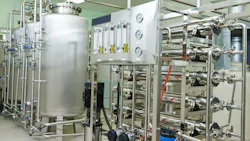





As municipal water utilities increasingly shift from free chlorine to chloramine disinfection strategies, pharmaceutical manufacturers are facing new challenges in maintaining consistent, high-purity water systems. While chloramines provide utilities with longer-lasting residual disinfection and reduced formation of regulated disinfection byproducts, they also introduce operational risks inside pharmaceutical facilities. As a result, manufacturers are reassessing traditional chloramine removal approaches and exploring more proactive treatment strategies that improve resiliency, monitoring, and long-term operational efficiency.
In a recent episode of Off Script sponsored by Trojan Technologies, we spoke with Wayne Lem, global applications manager at Trojan Technologies, about the evolving role of UV technology in pharmaceutical water treatment systems.
Q: Pharmaceutical manufacturers rely on municipal feed water, but utility disinfection strategies have evolved significantly in recent years. What changes are you seeing around the increased use of chloramines, and why does that matter for pharmaceutical facilities?
A: One of the biggest changes we've seen over the last couple of decades is the shift from free chlorine to chloramine in the municipal drinking water systems. So, utilities made that shift largely because chloramine is more stable. It lasts longer in the distribution system and it helps minimize disinfection byproducts like trihalomethanes (THMs) and Haloacetic acids (HAAs).
You may have heard of the EPA stage one and stage two disinfection byproduct rules. Those really accelerated that transition. Utilities also like chloramine because it maintains a longer lasting disinfectant residual throughout the distribution system. Now, for most consumers, that change is invisible, but for pharmaceutical manufacturers, it's a pretty significant shift because many pharmaceutical water systems were originally designed around free chlorine removal.
And therein lies the challenge, which is that chloramine is much harder to remove than free chlorine using traditional approaches like activated carbon or reducing chemicals. And if chloramine residual isn't properly controlled, it can create problems downstream. Things like oxidative damage to RO membranes, impact to ion exchange resins, membrane fouling, and, ultimately, water quality and operational concerns in high purity or ingredient water application. So really, what utilities see as a distribution system benefit can become a major treatment challenge inside a pharmaceutical facility.
Q: What are some downstream impacts chloramines can have on pharmaceutical water systems and process equipment if they aren't properly managed?
A: If chloramines are not properly removed, they can degrade RO membranes and ion exchange resins over time. They can increase membrane fouling potential and compromise overall water system performance. And for pharma, as you know, consistency is everything.
So there's the US Pharmacopeia (USP) Chapter 1231 on water for pharmaceutical purposes. And it talks extensively about maintaining robust system design, feed water control, and consistent chemical and microbial water quality throughout the purification process. There's also the FDA guidance for pharmaceutical and high purity water systems that says very similar things that changes in incoming feed water quality can directly affect downstream and purification performance and treatment liability and system reliability.
This isn't just theoretical. There was a situation where a municipality actually performed chlorine shock treatment on its distribution system and switched to chloramine without notifying the pharmaceutical facility in advance. This was bad because it upset the pharmaceutical facility's treatment train. It caused these byproducts I talked about earlier—trihalomethanes (THMs) and total organic carbon (TOC)—to exceed critical control points. The plant ended up shutting down production for more than 10 hours, and in the end, the financial impact was in the millions of dollars.
So, in short, for pharma facilities, chloramine management is not just a water treatment issue. It's also a production reliability issue.
Q: Historically, facilities have relied on approaches like activated carbon or chemical reduction for chloramine removal. What limitations are manufacturers running into with those methods today?
A: Many users in pharmaceutical facilities are very familiar with activated carbon. It's been around the industry for a long time. It's the workhorse of the industry for chlorine reduction. However, that's primarily for free chlorine.
But chloramine is a different animal. It's significantly harder to remove. So, to compensate for this, facilities often need what we call catalytic carbon. They need larger vessels. They need a lower throughput or flow rate through this catalytic carbon vessel and they're going to require frequent media or carbon replacement.
And then there's the operational side of it. Carbon systems require backwashing, hot water sanitization, frequent media changeouts, and monitoring and sampling. And carbon vessels are also a common breeding ground for bacteria because they capture the organic carbon, which is food source for the bacteria, which is something pharmaceutical facilities are very sensitive to.
Then on the chemical side, there's also plants that use reducing agents or chemicals such as sodium bisulfite. And these chemicals do work, but now you're introducing chemical handling, dosing systems, and you have monitoring requirements for these chemicals. There’s also the risk of overdosing these reducing chemicals. That can impact downstream membranes, as they can change the water chemistry because you're adding another chemical, and it can increase the operational complexity of your process.
So increasingly, what we see is that facilities are looking for solutions that reduce maintenance, reduce the amount of chemicals used or chemical dependency, and they try to improve the process resiliency or uptime through the process for treating the water.
Q: Where does UV technology fit into modern pharmaceutical water treatment strategy and how does it help manufacturers manage chloramine risk more proactively?
A: UV technology fits very nicely as a proactive and a non-chemical chloramine destruction step. It's typically installed upstream of RO membranes. And the reason for this is to protect downstream equipment or downstream processes or assets that you have. So, what UV is doing is called photolysis, which is a technical term where UV is essentially used to break down the chemical bonds in monochloramine, and end up destroying the chloramine without adding any chemicals to the water.
There's two main UV technologies in the market I should touch on to provide some context. There's medium pressure UV and low pressure UV systems. Medium pressure UV systems produce what we call a broad spectrum of UV wavelengths and are commonly used in some municipal and advanced oxidation applications. Whereas low pressure UV systems produce primarily 254-nanometer wavelength UV light. And that's important because monochloramine absorbs UV primarily and efficiently at 254.
So, with low pressure UV systems, Aquafine has the Avant and OptiVenn product line that are designed specifically for this application, which ends up being much more energy efficient for chlorine destruction. Now, a lot of the broad spectrum medium pressure UV systems aren’t useful for chloramine destruction and the energy ends up being lost or wasted as heat. And I would also say that another important benefit is that while UV is destroying chloramine, it's almost also simultaneously disinfecting. What that means is you're getting greater than 3 log or 99.9% of bacterial inactivation. This helps reduce biofouling and keeps downstream membranes cleaner longer.
And one thing we've demonstrated that's interesting is a synergy between UV and activated carbon. And what that means is for plants that have existing carbon, UV can be put in front of carbon and it can be used to significantly reduce the chloramine loading on the carbon and also inactivate the bacteria upstream. What this means is that it can extend carbon life downstream, it can reduce the bio growth in the carbon vessels, and it can lower the maintenance and overall improve the system reliability of the plant.
Q: In regulated manufacturing environments, consistency and verification are critical. How can manufacturers validate that a UV chloramine reduction system is performing effectively in real time?
A: In pharmaceutical manufacturing, you can't just assume performance. You have to continuously verify it. Now, modern UV systems have built-in monitoring tools such as UV intensity sensors to monitor the lamp output. We have lamp status monitoring, flow monitoring, as well as alarms and data logging.
So, operators can verify that the reactor is operating within what we call its validated performance envelope in real time. Then on the water quality side, you now have ultra low range online total chlorine analyzers that can continuously monitor residual chlorine and chloramine levels downstream.
For example, we've used analyzers like the Hach Ultra Low Range CL17, and that's an analyzer that can measure total chlorine down to about eight parts per billion in real time. And that's important because many membrane manufacturers now specify extremely low chlorine residuals that are allowable on the membranes on these RO systems. So instead of relying on periodic grab samples for water chemistry, facilities can now continuously verify chloramine destruction performance and proactively protect their downstream treatment assets and equipment throughout the process.
Q: As pharmaceutical manufacturers look to improve both efficiency and sustainability, how does UV compare economically with more traditional chloramine reduction approaches over the long term?
A: When you first look at carbon systems, people often focus only on the carbon media cost. But the real operating cost of carbon is much bigger than that. So with carbon there is backwashing, hot water sanitization, water usage, labor, monitoring, media replacement, auxiliary equipment, maintenance, downtime. That's just to name a few, and all of this adds up.
With UV, you avoid the chemical addition because UV doesn't require chemicals, you eliminate any carbon handling, you reduce maintenance, and you usually reduce footprint substantially as well. As an example, we conducted an economic comparison where we looked at a typical pharmaceutical application, reducing chloramine from 2 ppm down to less than 20 ppb. That's a 99% reduction of chloramine.
The UV solution reduced the capital cost by roughly half, and it also reduced the annual operating cost by about 25% versus catalytic carbon. Where I mentioned earlier, catalytic carbon systems can also require hundreds of hours per year of labor and oversight. And footprint-wise, UV systems are typically on average around 50% smaller. Another important point is energy efficiency. When you look at low pressure UV systems compared to medium pressure systems, low pressure systems use roughly one-third the power of medium pressure UV systems for chloramine applications. And from a sustainability standpoint, what this means is that UV reduces waste streams associated with carbon replacement. It also uses a lot less energy and doesn't require any chemical transport, storage, disposal, and handling. And that overall translates to a much safer customer experience and also for the operators.
Q: And as pharmaceutical manufacturers continue modernizing water infrastructure and pursuing more resilient operations, where do you see chloramine management strategies evolving over the next several years?
A: I think the industry is moving towards a much more proactive and data-driven water management strategy, especially with the increased use of machine learning, AI, and data-driven systems.
Pharmaceutical facilities are recognizing that. They're also recognizing that municipal feed water conditions can and do change quickly, and sometimes without notice. So, there's growing emphasis on resiliency, continuous monitoring, and protecting a plant's downstream treatment assets. At the same time, there's increasing focus on maintaining what I call highly consistent purity water for ingredient water, and also for other types of high purity pharmaceutical applications.
So even relatively small changes in incoming disinfectant chemistry can impact downstream purification performance. It can also impact membrane integrity,
your TOC, your microbial control strategies, and ultimately the consistency of your pharmaceutical water quality.
So there's an interdependency on the water that's coming in and all your treatment processes combined together. So facilities are looking for treatment approaches that provide tighter control, better predictability and improved operational stability.
And I think we're going to see the trend towards more hybrid treatment approaches. For example, UV as a primary chloramine destruction technology combined with carbon as a polishing or backup step. And this is sometimes also referred to as a multi-barrier approach. So, if one fails, you have a redundancy or a backup.
That combination can reduce the carbon loading, it can extend the media life, reduce maintenance, improve up time, and in the end, also minimize biofouling risks, where pharmaceutical plants don't want anything to do with bacteria or microorganisms because it affects the product quality in the ingredient water.
So as utilities today continue to optimize disinfection strategies to balance pathogen control with relation to disinfection byproduct reduction, chloramination isn't going away anytime soon. I think the trend is toward systems that are more resilient, more automated, more sustainable, and less dependent on heavy chemical usage and intensive maintenance. And that's where UV technology for chloramine destruction is an ideal solution.
Q: Is there anything you wanted to add regarding chloramine management and where UV systems fit into that.
A: If you have a chloramine destruction application you'd like to look at— whether you have questions on sizing, or what are the economics with the OpEx or CapEx, what it's going to cost for carbon versus UV—we have commercial teams that can perform those analysis for you. We can also provide a quote for you so that you could look at which of our systems, whether it's the Aquafine or OptiVenn brand, would be ideal for your specific application.
Because each application is unique—whether it's focused on incoming concentration of chloramine or how much reduction you need or the flow rate or the water quality—it's best to reach out to an Aquafine commercial representative and inquire about your specific design scenario or design conditions.