Trump inks drug pricing, tariff deals with nine biopharma companies
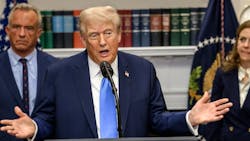
President Donald Trump continues to advance his Most Favored Nation (MFN) pricing program intended to lower U.S. prescription drug prices. The White House on Friday announced agreements with nine biopharmaceutical companies including Amgen, Boehringer Ingelheim, Bristol Myers Squibb, Genentech, Gilead Sciences, GSK, Merck, Novartis, and Sanofi.
The deals follow a similar pattern to previous agreements with AstraZeneca, Eli Lilly, EMD Serono, Novo Nordisk, and Pfizer. The terms of the agreements include a three-year grace period under which the companies’ respective products will not be subject to Section 232 investigation tariffs, provided the drugmakers continue to invest in U.S. manufacturing.
The nine biopharma companies have committed to investing at least $150 billion collectively in U.S. manufacturing in the near term, according to the White House announcement. Genentech/Roche previously said it will invest $50 billion in U.S. manufacturing, infrastructure, and R&D, while Gilead has pledged $32 billion in U.S.-based capital expenditures and GSK committed to investing $30 billion domestically.
Trump has been using the threat of pharma tariffs as leverage for his MFN policy. In late July, Trump sent letters to 17 major biopharma companies demanding they get onboard with the drug pricing and warning that if they refuse his administration “will deploy every tool in our arsenal” to ensure compliance.
Letters were sent to AbbVie, Amgen, AstraZeneca, Boehringer Ingelheim, Bristol Myers Squibb, Eli Lilly, EMD Serono, Genentech, Gilead, GSK, Johnson & Johnson, Merck, Novartis, Novo Nordisk, Pfizer, Regeneron, and Sanofi. Of those 17 biopharma companies targeted by Trump, only three remain to come to an MFN agreement with his administration — AbbVie, Johnson & Johnson, and Regeneron — but it was hinted at Friday’s White House press conference that additional announcements may be coming soon.
Regarding the deals with the nine companies announced on Friday, Trump said that if his administration didn’t wield the potential threat of pharma-specific tariffs, “we would never be able to do this.” Commerce Secretary Howard Lutnick said Trump is “not only driving prices down” for prescription drugs but bringing production back to the U.S.
Data and analytics firm GlobalData in a report last week said a “wave of transformative U.S. drug-pricing agreements and record manufacturing investments from leading biopharmaceutical companies is poised to reshape the global landscape for pharmaceutical access, production, and industrial policy.”
GlobalData noted that Eli Lilly has pledged an investment of $27 billion for four new U.S. manufacturing sites, while Novo Nordisk has committed to an additional $10 billion to expand and localize its U.S. production footprint including end-to-end manufacturing of a potential Wegovy tablet for weight loss.
“These agreements illustrate a new model in which pricing, access, and domestic industrial capacity are negotiated in tandem,” Edita Hamzic, healthcare analyst at GlobalData, said in a statement. “The U.S. is positioning itself as the anchor market for next-generation metabolic therapies.”
National health security
Friday’s announcement from the White House said that three companies involved in the drug pricing deals are donating active pharmaceutical ingredients (APIs) for key products to the Strategic Active Pharmaceutical Ingredients Reserve (SAPIR) to help “reduce reliance on foreign nations and ensure the United States has an adequate supply of such products in the event of an emergency.”
Bristol Myers Squibb will contribute tablets comprising 6.5 tons of apixaban, the active ingredient in its blood thinner drug Eliquis. GSK will donate 98.8kg of albuterol, the active ingredient in a rescue inhaler for asthma. Merck will provide 3.5 tons of ertapenem, an antibacterial medication used to treat complex infections.
In August, Trump signed an executive order directing the Office of the Assistant Secretary for Preparedness and Response (ASPR) to identify approximately 26 drugs critical to U.S. health and security, secure a six-month supply of APIs for the drugs, and prioritize domestic sourcing where possible.
“Only about 10% of the APIs by volume for the finished drug products used in the United States are made here,” Trump wrote in his executive order, which noted that the SAPIR created during his first administration is nearly empty.
About the Author
Greg Slabodkin
Editor in Chief
As Editor in Chief, Greg oversees all aspects of planning, managing, and producing the content for Pharma Manufacturing’s website and digital products, as well as the daily operations of its editorial team.
For more than 20 years, Greg has covered the healthcare, life sciences, and medical device industries for several trade publications. He is the recipient of a Post-Newsweek Business Information Editorial Excellence Award for his news reporting and a Gold Award for Best Case Study from the American Society of Healthcare Publication Editors. In addition, Greg is a Healthcare Fellow from the Society for Advancing Business Editing and Writing.
When not covering the pharma manufacturing industry, he is an avid Buffalo Bills football and Buffalo Sabres hockey fan, likes to kayak, and plays guitar.