Cellares looks to advance automated cell therapy manufacturing
At the 2026 Biotech Showcase in San Francisco last week, Alliance for Regenerative Medicine (ARM) CEO Tim Hunt predicted during his annual State of the Industry Briefing that the cell and gene therapy (CGT) sector is entering a period of disciplined and sustainable growth after years of volatility. A key component of this shift, Hunt noted, is a resurgence of financing — highlighted by $11.1 billion in capital flowing into the sector in 2025 — alongside increasingly robust partnership activity.
As these market dynamics potentially begin to ease long-standing headwinds, companies focused on commercializing cell therapies are accelerating their strategic and operational execution. At the same time, a little more than 10 miles south of where the ARM event was held, San Francisco-based Cellares is doing just that. A self-described integrated development and manufacturing organization (IDMO), Cellares is focused on building automated, scalable manufacturing technologies designed to expand patient access to cell therapies.
From platform development to manufacturing for patients
That execution for cell therapies is now extending into the clinic. On Jan. 12, the company announced FDA clearance for an IND amendment submitted by Cabaletta Bio, enabling Cellares to manufacture rese-cel, an investigational autologous CAR-T therapy, for use in clinical trials.
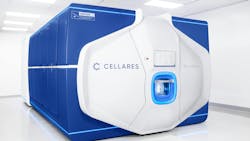
Manufacturing will take place on the company’s Cell Shuttle automated manufacturing platform and its Cell Q quality control workcell. The milestone marks the first time Cellares’ end-to-end manufacturing system will produce GMP drug product intended for patient infusion, with first patient dosing anticipated in the first half of 2026, according to the company.
“Autoimmune cell therapy programs operate at a fundamentally different scale of patient demand than oncology,” says Fabian Gerlinghaus, co-founder and CEO of Cellares. “Achieving scalability in these larger indications is a differentiated feature of the Cellares platform. FDA approval of Cabaletta’s IND amendment reflects regulatory confidence in the Cell Shuttle platform to deliver reliable GMP drug products at scale.”
The Cell Shuttle platform and Cell Q quality control workcell are central to Cellares’ mission toward the commercialization of cell therapies. In addition to its latest announcement with Cabaletta, both technologies featured prominently in the key company 2025 announcements, including several key collaboration milestones.
“Last year was a very good year for Cellares,” Gerlinghaus says. “We’re going to have a large financing announcement soon, and we were able to get a really significant round done with top-tier investors.”
This financing momentum will build on Cellares’ most recent major financing round, a $255 million Series C led by Koch Disruptive Technologies. The funding supported development of the company’s first IDMO “smart” factory, a 118,000-square-foot facility in Bridgewater, New Jersey, housing both the Cell Shuttle and Cell Q platforms.
Scaling a global manufacturing footprint
Since then, Cellares has continued expanding its global manufacturing footprint. In May 2025, the company announced plans for a commercial-scale smart factory in Kashiwa, Japan. Earlier this month, it followed with the announcement of a third commercial-scale facility in Leiden, the Netherlands, which will also serve as Cellares’ European headquarters and support manufacturing for Europe’s patient populations.
These expansions run in parallel with major commercial partnerships, most notably a $380 million capacity reservation and supply agreement with Bristol Myers Squibb for CAR-T cell therapy manufacturing.
“We’re seeing really strong operational progress and delivering on all the milestones for our $380 million partnership with Bristol Myers Squibb for commercial-scale manufacturing in the United States, Europe, and Japan,” Gerlinghaus says. “That’s why we’re building out these facilities.”
Regulatory endorsement, platform validation
Regulatory alignment has emerged as another defining theme. During ARM’s State of the Industry address, Hunt highlighted new FDA guidance issued earlier this month that provides increased regulatory flexibility around chemistry, manufacturing, and controls (CMC) requirements for CGTs, an effort aimed at accelerating patient access.
For Cellares, that regulatory momentum translated into a major endorsement in the form of an Advanced Manufacturing Technology (AMT) designation from the FDA’s Center for Biologics Evaluation and Research for its Cell Shuttle platform. The designation recognizes the platform’s ability to automate and reliably manufacture cell therapies at scale.
“While the FDA has granted AMT designations to a few companies, we were the first to receive one at all, and we’re still the only company to receive it for an end-to-end manufacturing platform,” Gerlinghaus contends. “It’s a strong endorsement from regulators.”
The designation also provides benefits for Cellares’ partners, allowing them to reference the AMT designation in regulatory filings and potentially streamline clinical advancement, according to the company.
For Gerlinghaus, the transition from platform development to GMP manufacturing represents a defining inflection point, both for Cellares and for how cell therapies can be manufactured at scale.
“After six and a half years of doing all of that, we’re now at the point where we’re about to make drugs that go into patients,” he concludes. “And in this way, we’re effectively establishing a GMP track record, which is a huge tailwind for us as a business.”
 awardscoverart
About the Author
Andy Lundin
Senior Editor
Andy Lundin has more than 10 years of experience in business-to-business publishing producing digital content for audiences in the medical and automotive industries, among others. He currently works as Senior Editor for Pharma Manufacturing and is responsible for feature writing and production of the podcast.
His prior publications include MEDQOR, a real-time healthcare business intelligence platform, and Bobit Business Media. Andy graduated from California State University-Fullerton in 2014 with a B.A. in journalism. He lives in Long Beach, California.