Autonomy isn’t automatic: Building toward the future of life sciences continuous manufacturing
Today’s life sciences manufacturers are facing a wider array of challenges than ever before. Globalization is reducing margins and simultaneously increasing competition, while shifting markets make it more complicated to do business. New treatment technologies are providing patients with more options, which leads to increased flexibility demands and a need to quickly, safely, and efficiently navigate associated regulatory requirements. All these challenges are further complicated by a limited pool of the expert personnel who help ensure treatments successfully make it through every step of the development and manufacturing pipeline.
Competing in this new world means doing everything possible to make manufacturing more efficient, including continuous manufacturing and associated automation. With this approach, operations teams can align strategies, equipment, and personnel across a wide array of different modalities to ensure the full value chain is coordinated and running at peak efficiency.
As the need for manufacturing efficiencies continues to increase and the demand for new treatment soars, continuous manufacturing has begun to evolve, but many organizations are looking beyond traditional continuous manufacturing to pursue autonomous manufacturing. New control and data technologies, robotics, and system integration solutions have come together to move autonomous operation out of the realm of science fiction into an achievable result.
Path from continuous to autonomous manufacturing
Automation of life sciences manufacturing using a continuous manufacturing strategy is not new. For decades, plants have been using digital technology to automate as much as possible, helping ensure that assets and processes are aligned across the full production line for a given modality. Teams have long known that what happens with one production unit impacts others, and that errors and delays in any step can have cascading effects that ripple across production, creating bottlenecks, unexpected deviations or inventory hold-ups.
Technologies like the distributed control system (DCS), manufacturing execution system (MES), and laboratory information management systems (LIMS) — along with real-time scheduling (RTS) software — have all been an essential part of building the continuous manufacturing platform. However, for many organizations, those systems have been fragmented, creating data silos and continuing to force reliance on significant manual intervention to keep the process going — particularly when it comes to analytical methods and process verification.
To address manual activities, companies are discovering and testing new kinds of automation — such as robotic arms, automated guided vehicles (AGVs), etc. — to make those process elements faster, more repeatable, more reliable, and less prone to error.
While the tools exist to make these changes happen, these new technologies alone cannot support autonomy. Such a solution also requires precise orchestration, seamless data integration and mobility, and dynamic process simulation to ensure the integrated solution maintains the safety, quality, and efficiency necessary to continue delivering treatments on schedule.
The rise of artificial intelligence (AI) and machine learning (ML) technologies are making the processes of testing and verification of all these connected technologies simpler and easier to perform. This helps teams more easily ensure they are getting the results they want when operating continuously.
The path to autonomous manufacturing relies on these four key elements: orchestration, integrated data, robotics, and simulation. In each of these elements, there are steps manufacturers can take today to begin setting the groundwork for the seamlessly integrated technology solutions that will unlock autonomous capability in years to come.
Precise orchestration
At the heart of successful manufacturing is the ability to prove successful execution. Operations teams need a way to prove not only that they have a successful recipe, but also that its execution was flawless. Electronic batch records should be able to easily demonstrate what the process was engineered to produce and how every step of that process is followed in production, while providing evidence that those steps were followed and the results were as expected.
Accomplishing this goal starts with a process knowledge management (PKM) solution to help teams clearly specify what is needed across all the elements of an autonomous process, from materials and equipment needs to the key operating models that will be used to ensure robotics, advanced control, and scheduling applications align. As a recipe increases in complexity across multiple technologies, paper specifications are no longer a viable solution for teams that want to develop continuous manufacturing strategies, much less autonomous ones.
Once teams have a reliable recipe specification, they need technologies to successfully execute that recipe. For years, the DCS and MES have been the critical orchestration layer for continuous manufacturing. However, as teams uplevel their capabilities to drive toward autonomous operation, they must contend with additional systems, such as inline process analytical technology (PAT), integrated at-line LIMS, and real-time exception reviews to manage quality control in real-time. RTS also plays a key part in determining any impact of material or equipment constraints on line and facility throughput.
As recipe solutions require more of this complex capability, the organizations most successfully orchestrating the automation layer are turning to a seamlessly integrated platform for PKM, DCS, MES, PAT, RTS, LIMS, and quality review management software. Integrated solutions on a platform eliminate the complexity of custom-engineered connectivity among isolated systems, freeing data and helping teams build the orchestration layer as a seamless whole for greater visibility and more intuitive operation.
However, simply ensuring the equipment is running properly is not enough. As teams embrace more autonomy in their continuous operations, they also need confidence that equipment and systems are working properly. To meet this need, plants add intelligent sensing devices to monitor health and manage calibration of assets, helping ensure they are all working per design. Seamlessly integrating this health and reliability management capability into the operations platform can work in tandem with the automation system to help plant personnel maintain continuous visibility of system health, while providing automated documentation of asset health and calibration for an easier regulatory review process.
Seamless data
Ultimately, a core technology that will unlock autonomous manufacturing is a unified industrial data fabric that allows information to flow across all the individual elements of production — equipment, material management, orchestration, scheduling, quality management, AI tools, and more. Many plants have taken the first steps in this direction by selecting software applications that can be seamlessly integrated by design.
A new foundational piece is the unified data fabric solution. An industrial data fabric connects plant operation applications together to provide aggregated, contextualized data across all the elements needed to run an autonomous plant. Teams leveraging a data fabric can easily connect process data, equipment data, analytical methods data, and reliability data into recipe execution and order scheduling applications seamlessly, and with associated context detailing what the data represents.
Making all this contextualized data easily available allows the orchestration layer to perform as designed. Advanced controls can optimize unit operations, upstream and downstream equipment can adjust operations based on what’s happening in real-time, quality targets can be met in real-time, and yield and throughput can be projected and delivered.
Integrated robotics
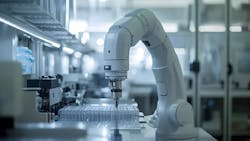
Once the data architecture and key technologies for continuous manufacturing are in place, teams can begin to leverage those technologies to go further, pushing them toward more autonomous operations with robotics. Material movements and additions have long required operators to move and add ingredients. AGVs have been proven in warehouse management solutions and have moved from operating inside the warehouse to also load/unload materials on the production floor. Robotic arms complete the task by adding the dispensed materials in the proper sequence as part of the overall orchestration. Other repetitive manual tasks, like taking and processing samples, can also be done with robotic arms to improve accuracy, efficiency, and safety.
While the development of humaniform robots is very uneven and they have not yet been proven to work in life sciences industrial settings, they are getting more and more exposure and presence in other manufacturing areas, like automotive and logistics. As examples of use cases expand, life science organizations interested in optimizing efficiency will start proving them out in their own operations.
Comprehensive simulation
Powerful automation, data management, and orchestration are important, but another critical component to unlocking autonomous operation is simulation. Once a team has an idea for how to drive an autonomous process by applying robotics and advanced controls, they will need a cost-effective way to prove it works before they spend hundreds of thousands of dollars on development and verification. Modeling allows an organization to perform software testing to prove that it will work.
Today, organizations use simulation to prove success on standardized unit operations, including bioreactors, chromatography columns, filtration systems, and other equipment. Leading companies also use simulations of overall facility line throughput in combination with individual unit operations to dynamically model how the line will operate. This combination lets production prove their electronic batch records and controls will work, while also helping with debottlenecking and fine-tuning the line.
Then, instead of performing live production runs at a cost of hundreds of thousands of dollars and taking critical production equipment out of production as part of testing, in silico testing allows the team to perform hundreds of runs in a medium and/or high-fidelity model without wasting supplies or equipment on each run. The model will tell the team whether the process runs to specification, and the team can follow up with three or four runs using actual materials to prove it out with certainty.
Preparing for the future
Though a fully autonomous lights out plant may still be well over the horizon, moving from continuous manufacturing to autonomous manufacturing for some critical product lines is not an unreachable goal. Advancements in technology — particularly inline analytical testing and robotics — have made it possible for operations teams to prove that the critical steps necessary to dramatically increase automation and reduce variability and human error can be automated.
The foundation of such an effort lies in having comprehensive orchestration, with seamlessly integrated DCS, MES, LIMS, and RTS at high levels of operation. Having those elements in place and dialed in will help ensure that automation technologies operate as expected, deliver results, and generate proper reporting to navigate regulatory oversight.
The next level is ensuring comprehensive data integration and collection. Teams collect a lot of data, not just from the DCS and MES, but from analytics, reliability, building management, and other systems. An industrial data fabric can aggregate and standardize that data, while maintaining all its critical context to make it instantly accessible and usable anywhere across the facility.
Finally, the team will need to implement advanced technologies, such as robotics, to manage sampling, material handling, and other tasks, which will free up operators for higher-level tasks and enhance their ability with AI co-pilots. Doing so will help eliminate errors and variability, while allowing teams to use their most experienced personnel for oversight-centered tasks that create more value.
The journey to more autonomous operations will not be completed overnight, but fortunately, every step incrementally improves existing operations. Starting that journey today provides a greater chance of capturing the competitive advantage inherent in autonomous operations, while delivering technologies that will transform a plant’s current operations for more efficiency, safety, and quality — a win-win at every stage.
About the Author
Bob Lenich
Business Director, Industrial Software, Emerson
Bob Lenich is director of global life sciences at Emerson. He is a life-long learner who stays engaged in new technology and organizational trends. In his 40+ years in the industry, Bob continually aims to solve operating issues across the process industries to help Life Science manufacturing improve people’s lives. Bob has a BS in Chemical Engineering from Rose Hulman Institute of Technology and an MBA from the University of Texas.